June 2, 2026

The Impact of Harmonics: How VFDs Affect Power Quality and How to Mitigate It

Introduction

Variable Frequency Drives (VFDs) have revolutionized industrial automation by providing precise speed control, reducing energy consumption, and improving process efficiency. They are widely employed in pumps, fans, compressors, conveyors, HVAC systems, and numerous manufacturing applications. Despite their many advantages, VFDs introduce an electrical phenomenon known as harmonics, which can adversely affect power quality and system reliability.

Power quality has become a major concern in modern facilities because electrical systems now contain a large number of electronic devices and nonlinear loads. Harmonic distortion generated by VFDs can cause overheating, nuisance tripping, increased losses, and interference with sensitive equipment. Therefore, understanding the source of harmonics and implementing effective mitigation techniques are essential for maintaining a healthy electrical system.


Understanding Power Quality

Power quality refers to the ability of an electrical system to provide stable voltage and current to connected loads. In an ideal situation, both voltage and current waveforms should be perfect sine waves.

Good power quality provides several benefits:

·       Improved system efficiency

·       Lower energy losses

·       Reduced equipment failures

·       Increased reliability

·       Longer component life

·       Stable process operation

Any disturbance that alters the shape of voltage or current waveforms reduces power quality. Harmonics are among the most common causes of such disturbances.


What Are Harmonics?

Harmonics are unwanted frequencies superimposed on the fundamental frequency of the power system. These frequencies are integer multiples of the fundamental frequency.

For a 50 Hz supply system:

·       Fundamental frequency = 50 Hz

·       Third harmonic = 150 Hz

·       Fifth harmonic = 250 Hz

·       Seventh harmonic = 350 Hz

·       Eleventh harmonic = 550 Hz

These additional frequency components distort the original sinusoidal waveform and create undesirable effects throughout the electrical network.


Why Variable Frequency Drives Generate Harmonics

VFDs are classified as nonlinear loads. Unlike resistive loads that draw current smoothly, VFDs consume current in short pulses.

Internally, a VFD consists of three major sections:

Rectifier

Converts AC power into DC power.

DC Bus

Stores and smooths the DC voltage.

Inverter

Converts DC power back into variable-frequency AC power.

The rectifier section, which normally contains six diodes, is mainly responsible for harmonic generation. Because current is drawn only during certain portions of the voltage cycle, the resulting current waveform becomes distorted.


Current Waveform Distortion

Under ideal conditions, current follows a smooth sinusoidal pattern. However, the pulsed current drawn by a VFD produces waveform distortion.

The higher the distortion, the greater the harmonic content.

This distortion affects not only the drive itself but also transformers, cables, generators, capacitors, and other equipment connected to the same power system.


Total Harmonic Distortion (THD)

The amount of waveform distortion is expressed by Total Harmonic Distortion (THD).

THD indicates the percentage of harmonic content relative to the fundamental component.

Lower THD values represent better power quality, while higher values indicate increased distortion and greater stress on electrical equipment.

Most industrial facilities attempt to maintain THD within acceptable limits specified by international standards.


Common Harmonics Produced by VFDs

Six-pulse Variable Frequency Drives typically generate characteristic harmonics such as:

·       Fifth harmonic

·       Seventh harmonic

·       Eleventh harmonic

·       Thirteenth harmonic

·       Seventeenth harmonic

·       Nineteenth harmonic

Among these, the fifth and seventh harmonics usually possess the highest magnitude and are responsible for most power quality issues.


Effects of Harmonics on Electrical Systems

Transformer Overheating

Harmonic currents increase copper losses and core losses inside transformers. This additional heating reduces insulation life and may lead to premature failure.

Cable Heating

Conductors carrying harmonic currents experience greater losses. Excessive heating can damage insulation and shorten cable life.

Motor Temperature Rise

Harmonics create additional losses within the stator and rotor. These losses increase motor temperature and reduce efficiency.

Capacitor Failures

Power factor correction capacitors are particularly vulnerable to harmonic frequencies. Excessive harmonic currents may cause overheating, swelling, and catastrophic failure.

False Tripping of Protection Devices

Circuit breakers and protective relays may operate unexpectedly because harmonic currents alter their sensing characteristics.

Reduced Generator Performance

Generators supplying nonlinear loads often experience voltage distortion and reduced efficiency.

Interference with Electronic Equipment

Sensitive devices such as PLCs, instrumentation systems, communication networks, and measurement equipment may experience erratic operation because of electromagnetic interference caused by harmonics.


IEEE 519 Standard

IEEE 519 is an internationally recognized guideline for harmonic control.

Its objectives include:

·       Limiting current distortion

·       Maintaining acceptable voltage quality

·       Protecting utility systems

·       Improving equipment reliability

·       Ensuring proper operation of connected loads

Many industries perform harmonic studies to ensure compliance with IEEE 519 recommendations.


Harmonic Mitigation Techniques

Several methods are available to minimize harmonic distortion in industrial systems.

Input Line Reactors

Line reactors are installed between the power supply and the VFD.

Their functions include:

·       Reducing harmonic currents

·       Limiting voltage spikes

·       Improving power factor

·       Protecting semiconductor devices

Line reactors are economical and widely used in industrial installations.


DC Link Chokes

A DC choke is placed in the DC bus section of the drive.

Benefits include:

·       Lower current ripple

·       Reduced THD

·       Improved efficiency

·       Increased capacitor life

Many modern VFDs include built-in DC chokes.


Passive Harmonic Filters

Passive filters consist of inductors and capacitors designed to block specific harmonic frequencies.

Advantages include:

·       Simple construction

·       Cost-effective operation

·       Reliable performance

·       Improved power quality

These filters are commonly used in medium-sized industrial systems.


Active Harmonic Filters

Active filters represent one of the most advanced harmonic reduction techniques.

These devices continuously monitor harmonic distortion and inject compensating currents to cancel unwanted frequency components.

Advantages include:

·       Dynamic correction

·       High accuracy

·       Adaptability to changing loads

·       Excellent harmonic suppression

Active filters are particularly suitable for facilities containing multiple VFDs.


Multi-Pulse Drives

Twelve-pulse and eighteen-pulse drives generate significantly fewer harmonics than conventional six-pulse drives.

Benefits include:

·       Lower THD values

·       Reduced transformer heating

·       Improved power quality

·       Better system reliability

However, these drives are generally more expensive and require special transformers.


Active Front End Drives

Active Front End (AFE) technology replaces traditional diode rectifiers with IGBT-based converters.

AFE drives provide:

·       Extremely low harmonic distortion

·       Near-unity power factor

·       Bidirectional power flow

·       Regenerative capability

These drives are commonly used in high-performance applications where power quality is critical.


Best Engineering Practices

To minimize harmonic-related problems, engineers should follow several important guidelines:

·       Perform harmonic analysis during system design.

·       Select VFDs according to application requirements.

·       Install line reactors where necessary.

·       Consider passive or active filters for large installations.

·       Monitor power quality regularly.

·       Avoid excessive capacitor banks without proper studies.

·       Ensure adequate transformer sizing.

·       Evaluate future system expansion.

A proactive approach during the design stage often prevents costly problems later.


Future Trends in Harmonic Control

As Industry 4.0 and smart manufacturing continue to evolve, harmonic mitigation technologies are becoming increasingly sophisticated.

Emerging developments include:

·       Intelligent active filters

·       AI-based power quality monitoring

·       Digital twin technology

·       Real-time harmonic analysis

·       Cloud-connected energy management systems

·       Smart predictive maintenance platforms

These innovations will help industries maintain cleaner electrical networks and improve overall system efficiency.


Conclusion

Variable Frequency Drives have transformed industrial motor control by delivering exceptional energy savings and operational flexibility. However, their nonlinear nature introduces harmonics that can negatively affect power quality and system reliability.

Excessive harmonic distortion may result in overheating, equipment failures, nuisance tripping, and reduced efficiency. Fortunately, these challenges can be effectively addressed through proper engineering practices and the use of line reactors, DC chokes, passive filters, active filters, multi-pulse drives, and Active Front End technology.

Understanding the impact of harmonics and implementing appropriate mitigation strategies enables industries to achieve cleaner power systems, improved reliability, enhanced equipment life, and greater overall efficiency. As electrical systems become increasingly sophisticated, harmonic management will remain an essential aspect of modern industrial power engineering.

June 1, 2026

The Anatomy of a VFD – Understanding Rectifiers, DC Bus, and Inverters

Introduction

Variable Frequency Drives are widely used in modern industries for controlling AC motor speed. A VFD improves energy efficiency, provides smooth starting, and reduces maintenance costs. Although the internal operation appears complex, it can be understood by dividing the drive into three sections: Rectifier, DC Bus, and Inverter.Variable Frequency Drives are widely used in modern industries for controlling AC motor speed. A VFD improves energy efficiency, provides smooth starting, and reduces maintenance costs. Although the internal operation appears complex, it can be understood by dividing the drive into three sections: Rectifier, DC Bus, and Inverter.Variable Frequency Drives are widely used in modern industries for controlling AC motor speed. A VFD improves energy efficiency, provides smooth starting, and reduces maintenance costs. Although the internal operation appears complex, it can be understood by dividing the drive into three sections: Rectifier, DC Bus, and Inverter.Variable Frequency Drives are widely used in modern industries for controlling AC motor speed. A VFD improves energy efficiency, provides smooth starting, and reduces maintenance costs. Although the internal operation appears complex, it can be understood by dividing the drive into three sections: Rectifier, DC Bus, and Inverter.

Why VFDs are Used

Traditional motors operate at fixed speed. Many applications such as pumps, fans, and conveyors require variable speed. A VFD allows speed control according to process demand, reducing energy consumption and improving productivity.Traditional motors operate at fixed speed. Many applications such as pumps, fans, and conveyors require variable speed. A VFD allows speed control according to process demand, reducing energy consumption and improving productivity.Traditional motors operate at fixed speed. Many applications such as pumps, fans, and conveyors require variable speed. A VFD allows speed control according to process demand, reducing energy consumption and improving productivity.Traditional motors operate at fixed speed. Many applications such as pumps, fans, and conveyors require variable speed. A VFD allows speed control according to process demand, reducing energy consumption and improving productivity.

Overall Working Principle

The VFD converts AC power into DC power and then converts it back into variable-frequency AC power. This allows accurate control of motor speed and torque.The VFD converts AC power into DC power and then converts it back into variable-frequency AC power. This allows accurate control of motor speed and torque.The VFD converts AC power into DC power and then converts it back into variable-frequency AC power. This allows accurate control of motor speed and torque.The VFD converts AC power into DC power and then converts it back into variable-frequency AC power. This allows accurate control of motor speed and torque.

Rectifier Section

The rectifier is the first section of the VFD. Its purpose is to convert incoming AC power into DC power. Semiconductor diodes act like one-way valves and allow current to flow in only one direction. The output produced by the rectifier is pulsating DC voltage.The rectifier is the first section of the VFD. Its purpose is to convert incoming AC power into DC power. Semiconductor diodes act like one-way valves and allow current to flow in only one direction. The output produced by the rectifier is pulsating DC voltage.The rectifier is the first section of the VFD. Its purpose is to convert incoming AC power into DC power. Semiconductor diodes act like one-way valves and allow current to flow in only one direction. The output produced by the rectifier is pulsating DC voltage.The rectifier is the first section of the VFD. Its purpose is to convert incoming AC power into DC power. Semiconductor diodes act like one-way valves and allow current to flow in only one direction. The output produced by the rectifier is pulsating DC voltage.

DC Bus Section

The DC Bus is the energy storage section. Capacitors store energy and smooth voltage fluctuations while inductors reduce electrical noise. The DC Bus provides stable DC voltage to the inverter section.The DC Bus is the energy storage section. Capacitors store energy and smooth voltage fluctuations while inductors reduce electrical noise. The DC Bus provides stable DC voltage to the inverter section.The DC Bus is the energy storage section. Capacitors store energy and smooth voltage fluctuations while inductors reduce electrical noise. The DC Bus provides stable DC voltage to the inverter section.The DC Bus is the energy storage section. Capacitors store energy and smooth voltage fluctuations while inductors reduce electrical noise. The DC Bus provides stable DC voltage to the inverter section.

Inverter Section

The inverter converts smooth DC voltage back into AC voltage. Modern VFDs use IGBTs and Pulse Width Modulation technology. By changing frequency, the inverter controls motor speed.The inverter converts smooth DC voltage back into AC voltage. Modern VFDs use IGBTs and Pulse Width Modulation technology. By changing frequency, the inverter controls motor speed.The inverter converts smooth DC voltage back into AC voltage. Modern VFDs use IGBTs and Pulse Width Modulation technology. By changing frequency, the inverter controls motor speed.The inverter converts smooth DC voltage back into AC voltage. Modern VFDs use IGBTs and Pulse Width Modulation technology. By changing frequency, the inverter controls motor speed.

PWM Technique

Pulse Width Modulation is a switching technique used by modern VFDs. Thousands of pulses are generated every second to produce a waveform similar to a sine wave. PWM provides efficient motor control and better performance.Pulse Width Modulation is a switching technique used by modern VFDs. Thousands of pulses are generated every second to produce a waveform similar to a sine wave. PWM provides efficient motor control and better performance.Pulse Width Modulation is a switching technique used by modern VFDs. Thousands of pulses are generated every second to produce a waveform similar to a sine wave. PWM provides efficient motor control and better performance.Pulse Width Modulation is a switching technique used by modern VFDs. Thousands of pulses are generated every second to produce a waveform similar to a sine wave. PWM provides efficient motor control and better performance.

Practical Example

In a water pumping application, a VFD adjusts pump speed according to demand. When demand decreases, motor speed reduces and energy consumption drops significantly.In a water pumping application, a VFD adjusts pump speed according to demand. When demand decreases, motor speed reduces and energy consumption drops significantly.In a water pumping application, a VFD adjusts pump speed according to demand. When demand decreases, motor speed reduces and energy consumption drops significantly.In a water pumping application, a VFD adjusts pump speed according to demand. When demand decreases, motor speed reduces and energy consumption drops significantly.

Advantages

Major advantages include energy savings, smooth starting, reduced maintenance, better process control, longer equipment life, and improved reliability.Major advantages include energy savings, smooth starting, reduced maintenance, better process control, longer equipment life, and improved reliability.Major advantages include energy savings, smooth starting, reduced maintenance, better process control, longer equipment life, and improved reliability.Major advantages include energy savings, smooth starting, reduced maintenance, better process control, longer equipment life, and improved reliability.

Applications

VFDs are used in pumps, fans, HVAC systems, compressors, conveyors, mixers, machine tools, and process industries.VFDs are used in pumps, fans, HVAC systems, compressors, conveyors, mixers, machine tools, and process industries.VFDs are used in pumps, fans, HVAC systems, compressors, conveyors, mixers, machine tools, and process industries.VFDs are used in pumps, fans, HVAC systems, compressors, conveyors, mixers, machine tools, and process industries.

Conclusion

The Rectifier, DC Bus, and Inverter together form the heart of a Variable Frequency Drive. Understanding these sections provides a strong foundation for learning advanced motor control and industrial automation.The Rectifier, DC Bus, and Inverter together form the heart of a Variable Frequency Drive. Understanding these sections provides a strong foundation for learning advanced motor control and industrial automation.The Rectifier, DC Bus, and Inverter together form the heart of a Variable Frequency Drive. Understanding these sections provides a strong foundation for learning advanced motor control and industrial automation.The Rectifier, DC Bus, and Inverter together form the heart of a Variable Frequency Drive. Understanding these sections provides a strong foundation for learning advanced motor control and industrial automation.

Figure 1: Basic Structure of VFD

May 28, 2026

4-20 mA Signal Conversion: Mathematical Principles and Practical Calculations

Converting 4-20 mA analog signals to meaningful engineering units is one of the most fundamental tasks in PLC programming and industrial automation. While the concept is straightforward, mastering the mathematical principles and understanding the various calculation methods is essential for accurate process control and reliable system operation. This article explores the mathematical foundations of 4-20 mA signal conversion and provides practical calculation methods used in real-world industrial applications.

Basic Linear Conversion Formula

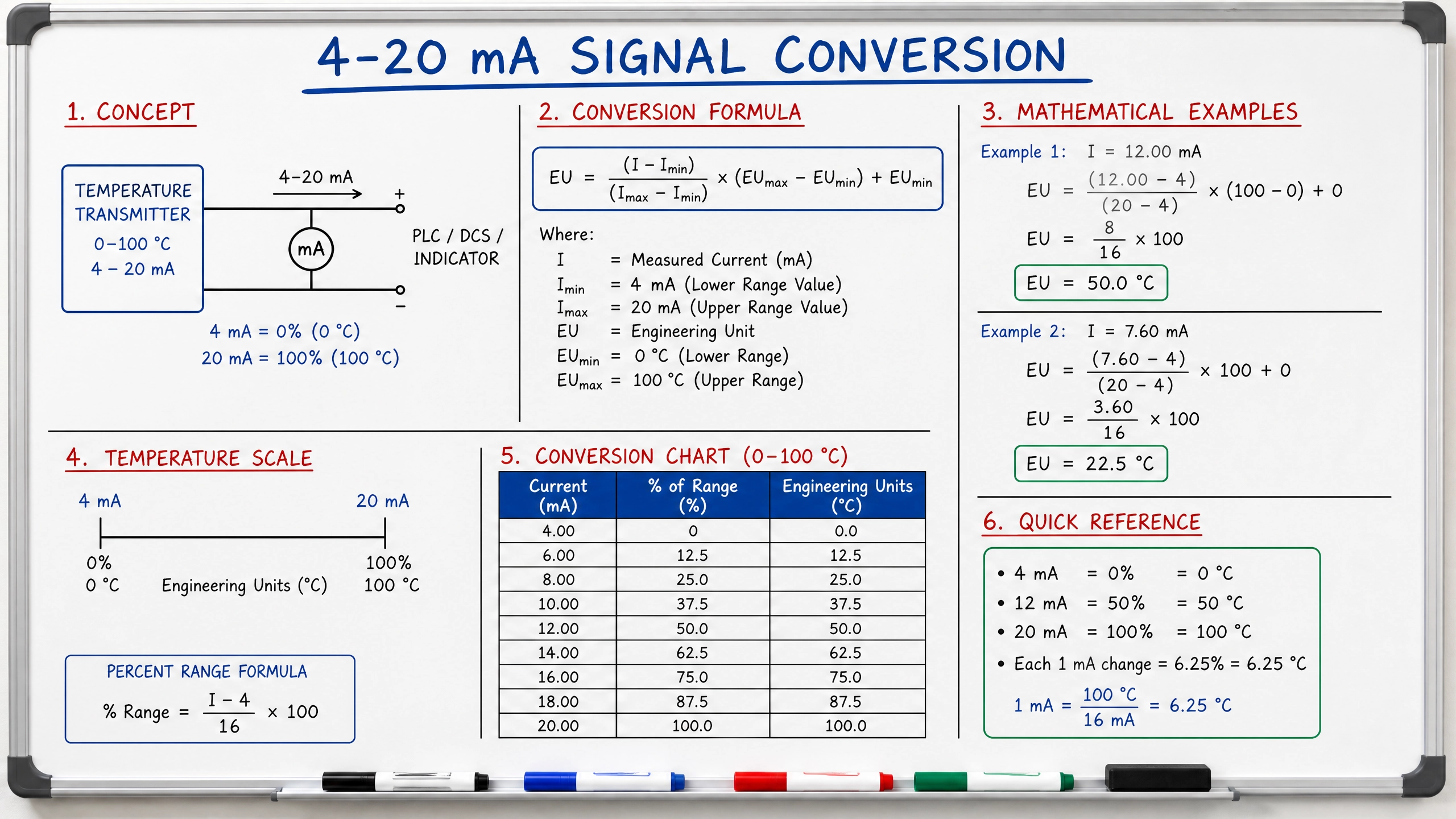
4-20 mA Signal Conversion Formula on Whiteboard
Figure 1: Technical Diagram Showing 4-20 mA Signal Conversion Formula and Mathematical Examples
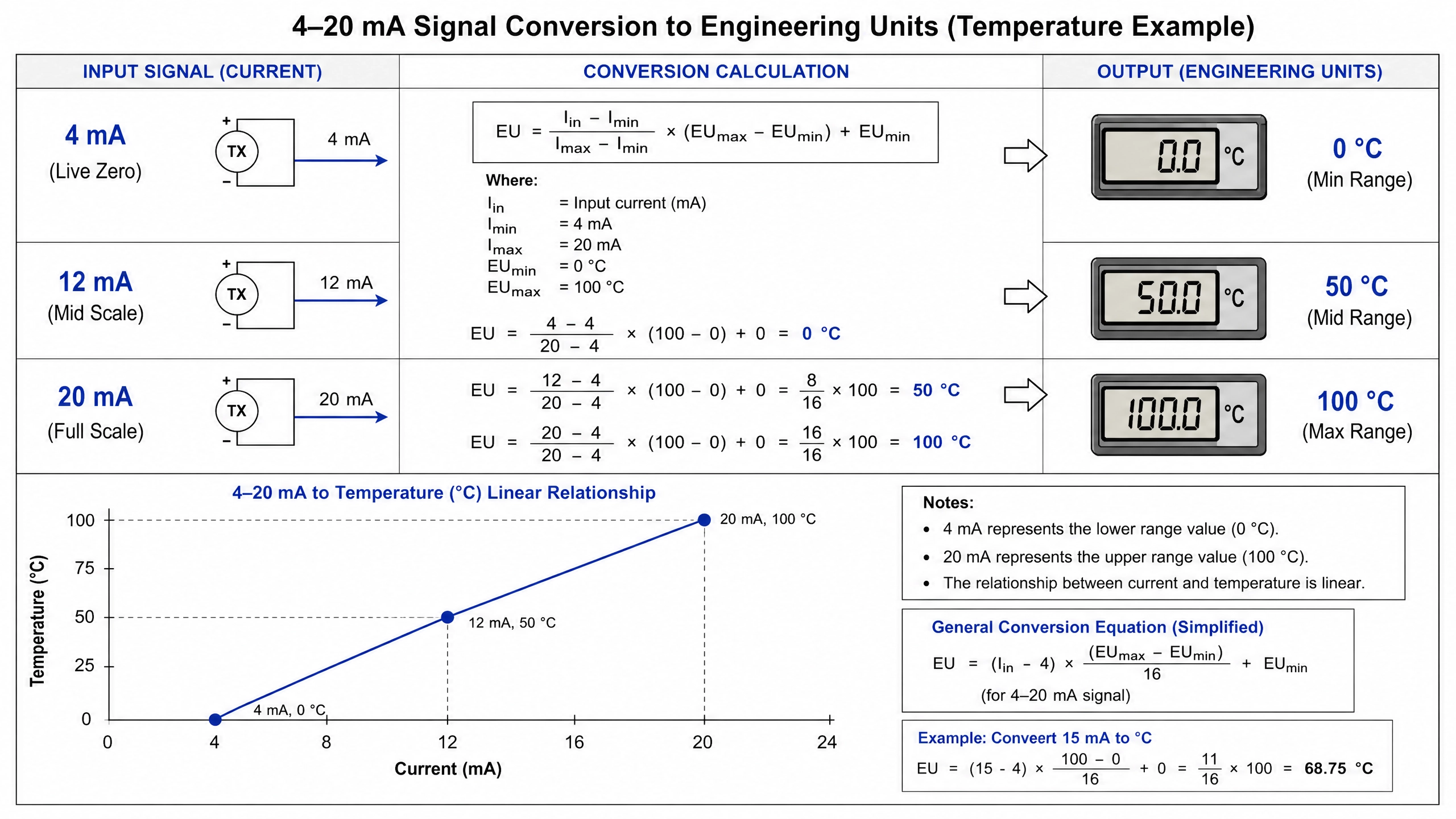
Signal Conversion Process
Figure 2: 4-20 mA to Engineering Units Conversion Steps

May 27, 2026

Predictive Maintenance: Using VFD Data to Forecast Motor Failure Before It Happens

Introduction

Unexpected motor failures can result in production losses, increased maintenance costs, and unplanned downtime. In many industries, a single motor failure can interrupt an entire manufacturing process and cause significant financial losses. Traditionally, maintenance activities were performed either after equipment failed or at fixed time intervals. While these approaches have been widely used for decades, they often lead to unnecessary maintenance or catastrophic breakdowns.

Modern Variable Frequency Drives (VFDs) have transformed maintenance practices by providing valuable operating data that can be used to predict equipment failures before they occur. Through continuous monitoring of electrical and mechanical parameters, VFDs enable industries to move from reactive maintenance to predictive maintenance.

Predictive maintenance allows engineers to identify early warning signs and schedule maintenance activities before serious damage occurs, thereby improving reliability and reducing operating costs.


Evolution of Maintenance Strategies

Industrial maintenance has evolved considerably over time.

Breakdown Maintenance

Equipment is repaired only after failure occurs.

Preventive Maintenance

Maintenance activities are scheduled at fixed intervals.

Predictive Maintenance

Condition monitoring data determines when maintenance is required.

Figure 15.1 Maintenance Evolution

Maintenance Strategy


Breakdown
    
    
Preventive
    
    
Predictive
    
    
Smart Maintenance

Predictive maintenance offers the most efficient balance between reliability and cost.


Why Predictive Maintenance Is Important

Unexpected motor failures can cause:

·       Production losses

·       Increased downtime

·       Expensive repairs

·       Reduced efficiency

·       Safety hazards

·       Customer delivery delays

By detecting abnormalities early, these problems can be minimized.


Role of VFDs in Condition Monitoring

Modern VFDs are much more than speed controllers. They act as intelligent monitoring devices capable of collecting large amounts of operational data.

Figure 15.2 VFD as a Monitoring Device

Motor
   
   
Operating Data
   
VFD
   
Analysis
   
Maintenance System

The drive continuously monitors motor performance and provides valuable information regarding equipment health.


Parameters Monitored by VFDs

Modern drives can measure and record several variables.

Motor Current

Current variations often indicate abnormal loading conditions.

Voltage

Voltage imbalance can affect motor performance.

Temperature

Excessive temperatures accelerate component deterioration.

Torque

Changes in torque may reveal mechanical problems.

Speed

Speed fluctuations can indicate load instability.

Frequency

Frequency trends provide insight into process conditions.

Power Consumption

Increased energy usage may indicate equipment wear.


Figure 15.3 Parameters Monitored by VFD

            VFD
             
 ┌───────────┼───────────┐


Current   Voltage    Temperature


Torque     Speed      Power

These parameters form the basis of predictive maintenance programs.


Current Signature Analysis

Motor current contains valuable information regarding machine condition.

Abnormal current patterns may indicate:

·       Bearing damage

·       Rotor defects

·       Misalignment

·       Overloading

·       Mechanical binding

Figure 15.4 Current Monitoring

Motor
  
Current Signal
  
  
VFD Analysis
  
  
Fault Detection

Current signature analysis is widely used because it does not require additional sensors.


Temperature Monitoring

Heat is one of the primary causes of motor failure.

High temperatures can lead to:

·       Insulation breakdown

·       Bearing deterioration

·       Reduced efficiency

·       Premature aging

Modern VFDs continuously monitor:

·       Heat sink temperature

·       Motor temperature

·       Ambient temperature

Trending temperature values helps identify developing problems.


Vibration Monitoring

Mechanical faults often generate abnormal vibration.

Common causes include:

·       Bearing wear

·       Shaft misalignment

·       Rotor imbalance

·       Loose foundations

Figure 15.5 Vibration Analysis

Motor
  
Vibration Sensor
  
  
Monitoring System
  
  
Trend Analysis

Increasing vibration levels provide early warning of mechanical failure.


Bearing Condition Monitoring

Bearings are among the most common failure points in electric motors.

Symptoms of bearing deterioration include:

·       Increased vibration

·       Elevated temperature

·       Unusual noise

·       Current fluctuations

Detecting these symptoms early prevents catastrophic failure.


Torque Monitoring

Torque values provide information about load conditions.

Sudden changes in torque may indicate:

·       Mechanical blockage

·       Conveyor jams

·       Pump cavitation

·       Process disturbances

Monitoring torque enables operators to identify process abnormalities before damage occurs.


Power Consumption Analysis

A gradual increase in power consumption often signals equipment deterioration.

Possible Causes

·       Bearing friction

·       Misalignment

·       Mechanical wear

·       Poor lubrication

Figure 15.6 Energy Trend

Power

      /
     /
    /
___/_____________

      Time

Increasing energy consumption should not be ignored.


Trend Analysis

Single measurements rarely reveal developing faults.

Trend analysis focuses on changes over time.

Figure 15.7 Trend Monitoring

Parameter Value

       /
      /
     /
____/____________

        Time

A gradual increase in temperature, current, or vibration usually indicates deteriorating equipment.


Alarm and Warning Functions

Modern VFDs provide:

·       High-temperature alarms

·       Overcurrent warnings

·       Overload indications

·       Voltage imbalance alarms

·       Communication fault notifications

These features allow maintenance personnel to take corrective action before a complete failure occurs.


Data Logging Capabilities

Most advanced drives maintain historical records of:

·       Fault events

·       Operating hours

·       Maximum current

·       Temperature history

·       Speed profiles

Historical information simplifies root-cause analysis.


Integration with SCADA Systems

VFD data can be transmitted to supervisory systems.

Figure 15.8 Industrial Connectivity

Motor
  
  
 VFD
  
Ethernet
  
  
 SCADA
  
  
Maintenance Team

This enables centralized monitoring of multiple motors across an entire facility.


Internet of Things (IoT) Applications

Industrial Internet of Things technology has enhanced predictive maintenance capabilities.

Benefits include:

·       Remote monitoring

·       Cloud-based analysis

·       Real-time notifications

·       Mobile alerts

·       Performance dashboards

Maintenance personnel can access machine data from virtually anywhere.


Artificial Intelligence and Machine Learning

Modern software platforms employ AI algorithms to analyze large volumes of operational data.

These systems can:

·       Detect abnormal patterns

·       Predict component life

·       Recommend maintenance actions

·       Reduce false alarms

Artificial intelligence is becoming increasingly important in Industry 4.0 environments.


Digital Twin Technology

Digital twins create virtual models of physical equipment.

Advantages

·       Simulation of operating conditions

·       Performance optimization

·       Early fault prediction

·       Reduced downtime

Digital twin technology represents the future of predictive maintenance.


Benefits of Predictive Maintenance

Implementing predictive maintenance provides numerous advantages.

Reduced Downtime

Failures are prevented before they occur.

Lower Maintenance Costs

Repairs are performed only when necessary.

Increased Reliability

Equipment availability improves significantly.

Extended Equipment Life

Components operate within safe limits.

Improved Productivity

Production interruptions are minimized.

Better Energy Efficiency

Healthy machines consume less power.


Challenges in Predictive Maintenance

Despite its advantages, several challenges exist.

Data Overload

Large amounts of information require analysis.

Sensor Reliability

Poor sensor quality affects accuracy.

Initial Investment

Advanced monitoring systems require capital expenditure.

Personnel Training

Engineers must understand data interpretation techniques.


Future Trends

Emerging technologies are further enhancing predictive maintenance:

·       Artificial Intelligence

·       Machine Learning

·       Digital Twins

·       Cloud Analytics

·       Edge Computing

·       Wireless Sensors

·       Smart Factories

These innovations are enabling industries to move toward fully autonomous maintenance systems.


Conclusion

Predictive maintenance represents a major advancement in industrial asset management. By utilizing the vast amount of information available from Variable Frequency Drives, industries can identify developing problems long before equipment failure occurs. Monitoring current, temperature, vibration, torque, and power consumption allows engineers to detect abnormalities, schedule maintenance efficiently, and avoid costly downtime.

As Industry 4.0 technologies continue to evolve, VFDs are becoming intelligent diagnostic tools capable of supporting advanced condition monitoring and predictive analytics. Organizations that embrace predictive maintenance strategies will achieve greater reliability, improved productivity, lower operating costs, and longer equipment life.

In modern manufacturing, maintenance is no longer about repairing equipment after failure—it is about preventing failure before it happens.