October 23, 2023

Unleashing the Power of Programmable Logic Controllers

Introduction:

Programmable Logic Controllers (PLCs) have revolutionized industrial automation, enabling efficient control and management of complex processes. At the core of every PLC lies its memory, a crucial component responsible for storing and executing programs that drive all automation functions. This article dives into the world of PLC memory, exploring its types, functions, and the technological advancements that have transformed industrial operations.


Types of PLC Memory:

PLC memory comprises several distinct types, each serving a specific purpose. These include:

Read-Only Memory (ROM): Non-volatile memory that stores the PLC's firmware and cannot be altered by the user.

Random Access Memory (RAM): Volatile memory used for storing program instructions and data during runtime.

Electrically Erasable Programmable Read-Only Memory (EEPROM): Non-volatile memory permitting limited user modifications, often utilized for storing critical configuration and parameter data.

Flash Memory: Non-volatile memory used for storing larger program sizes and frequently updated data.

Functions of PLC Memory:

PLC memory performs critical functions that enable seamless operation of industrial automation systems:

Program Storage: PLC memory stores the user-defined program instructions, ladder logic, or other programming languages required to control and monitor automated processes.

Data Storage: PLCs utilize memory to store real-time data, inputs, outputs, and variable values essential for efficient decision-making and process control.


Retention: Some PLC memory types, such as EEPROM or battery-backed RAM, offer data retention even during power outages, safeguarding vital data and system configurations.

Advancements in PLC Memory Technology:


With advancing technology, PLC memory has evolved to meet the needs of modern industrial processes. Some significant developments include:


Increased Capacity: The ever-growing memory capacity of PLCs allows for complex program storage, intricate control algorithms, and extensive data logging, facilitating advanced automation functions.


Faster Access Speeds: PLC memory has progressed to provide faster access speeds, enabling real-time processing and rapid execution of control functions.


Redundancy and Fault-Tolerance: Modern PLCs often incorporate redundant memory systems, ensuring data integrity and fault tolerance in critical applications.


Best Practices for Managing PLC Memory:

Effectively managing PLC memory is vital for reliable and efficient system performance. Here are some best practices to consider:


Optimize Program Size: Efficient coding techniques, modular programming, and minimizing unnecessary instructions help optimize memory utilization, ensuring efficient execution of program logic.


Regular Backups: Regularly backing up PLC memory data and program configurations mitigates the risk of data loss and facilitates faster recovery in the event of a failure or fault.

Memory Monitoring: Monitoring memory usage helps identify potential issues such as memory leaks or excessive memory usage, enabling proactive measures to maintain system performance.


March 24, 2023

AND OPERATION IN PNEUMATIC APPLICATION

Problem Description:

 Operation of the Double Acting Cylinder by using Two Buttons B1 and B2. When both B1 and B2 both are pressed then Cylinder will move forward and get retracts when any one of them releases.


 Pneumatic Diagram


In this Pneumatic Diagram We have used one Double Acting Cylinder, one 5/2 Pilot operated valve and two 3/2 Push Button valve with spring return.


Circuit Description


Here One Double Acting Cylinder is used with 5/2 pilot operated valve with spring return i.e. when in absence of pressure at pilot point it will automatically return to home position. Input at pilot point comes from the output of one of the 3/2 Push Button valves and input of that Push Button valve is the output of another 3/2 Push Button valve whose input relates to the pressure line. In other words, Both 3/2 Push Button valves are connected in series and output is given to a 5/2 pilot operated valve.


Here all valves are of Normally close (NC) type so, it won’t allow pressure to pass through the valve when they are in rest condition, or we can say it as a home position.


Working

 Case 1: PB1 is pressed.

When PB1 is pressed then as it is of NC type it will allow pressure to pass through it but at valve 2 where PB2 isn’t pressed pressure will not be able to pass through it so at pilot valve there is absence of pressure and therefore, Cylinder won’t move from it home position.

Case 2: PB2 is pressed.

When PB2 is pressed then the valve will get open and allow pressure to flow through it but as PB1 hasn’t pressed so there is absence of pressure at input of the second valve as a result there is absence of pressure at the pilot valve of 5/2. So, Cylinder will not move in this case also.

 Case 3: Both are pressed.

When both switches get pressed, our pilot valve is directly connected with the pressure line as both are of NC type so the cylinder will move in forward direction and when any of them get released then the cylinder will get retracted. 


This whole operation is similar to AND gate operation in Digital Electronics whose truth table is given below.


Note: - Above application may be different from actual application. This example is only for explanation purpose only. We can use this concept in other examples also. All parameters and graphical representations considered in this example are for explanation purpose only, parameters or representation may be different in actual applications. Also, all interlocks are not considered in the application.


                                                                                     Written by Sneh jain


Double acting pneumatic cylinder operation using 5/2 direction control valve and PLC

 Problem Statement: -

A heavy door is to be opened or closed by a double-acting cylinder. This door will open or close with two push buttons, one push button is located inside and another push button is located outside. Draw a Ladder Diagram for the Giving Condition.

a) The push button should only work when the door is either fully open or fully closed.


Solution: -

Number of inputs = 4

PB1: Inside push button

PB2: Outside push button

L1:  Limit switch located at closing position.

L2:  Limit switch located at open position.


Number of outputs = 2

Y1: Left Solenoid of 5/2 control valve

Y2: Right Solenoid of 5/2 control valve

Pneumatic Circuit Diagram:


Answer - (a): -

 Number of inputs = 4

Possibilities = 24 =16


Description: -

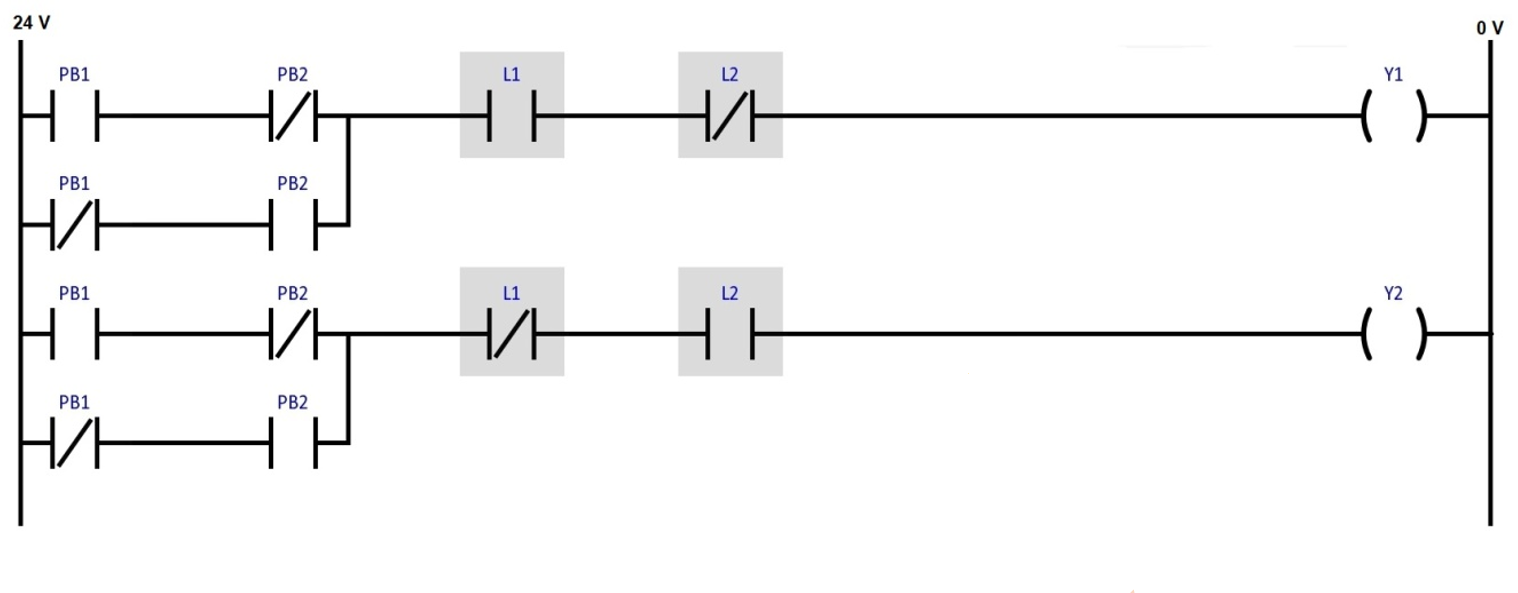
Initially, as the door is fully closed the L1 limit switch is pressed (L1=1 & L2=0), the door will only open when any one of the push buttons is pressed (PB1 =1 & PB2=0 OR PB1=0 & PB2=1)

It is not possible that both the Limit switches L1 & L2 are pressed at the same time   (L1=1 & L2=1).

Both the switches are unpressed (L1=0 & L2=0), which means the door is neither fully opened nor fully closed

As the door is fully closed the L1 limit switch is pressed (L1=0 & L2=1), the door will only open when any one of the push buttons is pressed (PB1 =1 & PB2=0 OR PB1=0 & PB2=1).

Hence, Y1= (L1) (L2)’ (PB1)’ (PB2) + (L1) (L2)’ (PB1) (PB2)’

               = (L1) (L2)’ [(PB1)’ (PB2) + (PB1) (PB2)’]


             Y2= (L1)’ (L2) (PB1)’ (PB2) + (L1)’ (L2) (PB1) (PB2)’

               = (L1)’ (L2) [(PB1)’ (PB2) + (PB1) (PB2)’]


Note: - Above application may be different from actual application. This example is only for explanation purpose only. We can use this concept in other examples also. All parameters and graphical representations considered in this example are for explanation purpose only, parameters or representation may be different in actual applications. Also, all interlocks are not considered in the application.


                                                                                            Written by Subham Prajapati

January 19, 2023

Operate the dump hopper using double acting pneumatic cylinder.

Problem Description: -

Material is to be emptied from the dump hopper. By pressing PB1 ,the dump hopper will be tilted, and bulk material is emptied out and by pressing the PB2 hopper is returned to its original position. 


Problem Diagram: -


Pneumatic Circuit: -


Solution

As Shown in diagram we can see one double acting pneumatic cylinder is used to tilt the hopper. With the cylinder open/close operation we can operate the hopper. We used two Push buttons to operate the hopper. So once operator press PB 1 , hopper will tilt at some angel and loose material will come out from the hopper and if operator will press PB 2, hopper will return to its home position.

Pneumatic circuit explanation: -

As shown in pneumatic circuit diagram, we need double acting pneumatic cylinder to operate hopper. Here we used two 3/2 valves and one double acting pneumatic cylinder for the application. If operator press PB 1 then Air flow will move from P to A so cylinder rod will come out and it will tilt the hopper. If PB2 is pressed, air flow will move from P to B so hopper will return to its original position.


Note: -Above application may be different from actual application. This example is only for explanation purpose only. We can implement this logic in other way also. All parameters and graphical representations considered in this example are for explanation purpose only, parameters or representation may be different in actual applications. Also, all interlocks are not considered in the application.


December 26, 2022

Single acting pneumatic cylinder operation using 3/2 direction control valve.

Problem Description: -

The operation of Single acting pneumatic cylinder by using two pushbuttons PB1 and PB2. PB1 is for start the operation and PB2 is for stop the operation.

Diagram: -

https://plcscadaacademy.blogspot.com


Here we took Single acting cylinder and 3/2 single solenoid spring return valve now we have to use electric circuit to operate solenoid.


Program: -

Here is PLC program for making START/STOP pneumatic cylinder operation using PLC.


List of Inputs/Outputs

List of Inputs

X0: -PB1

X1: -PB2

List of Outputs

Y0: -Cylinder Relay output

Ladder Diagram for single acting pneumatic cylinder operation using 3/2 direction control valve.


https://plcscadaacademy.blogspot.com


Program Description: -

-In the ladder diagram, we use two push button one for start (PB1) and other one to stop (PB2). And we also use relay for operate solenoid as shown in figure.

-We give direct 24 voltage to PB1 (NO) and then PB1 normally open contact to PB2 (NC) and then PB2 normally closed contact to the relay.

-Now we take one normally open contact of relay and give to the PB2 common to give continuous supply to the relay it is called latching and take second normally open contact of relay to the solenoid and give 0v to solenoid to complete circuit.

-Now when we press PB1 power supply to the relay and relay start. And by starting relay solenoid is also get power and operate valve. Now if we release PB1 but power to the solenoid will not stop because of latching.

-Now when we press PB2 contact will open stop the relay that’s why solenoid is also stop and cylinder will back at their normal position because of spring return valve.


                                                                                     By Mansuri Afnan


December 25, 2022

Sequential lamps operation using PLC

This is a PLC program for the sequential lamp operation.

Problem description: -

Write PLC program to operate lamps in sequential mode using ladder diagram Language.

 Problem diagram: -


Solution: -

Here in this system, there are two lamps, two bush buttons which are connected to the PLC.

 The bush buttons are connected to the PLC inputs and lamps are connected to the Outputs of the PLC.

There are following condition for the system to work which are as follows: -

1)    When START PB is to be pushed lamp1 should start and lamp 2 should start after 5 seconds of lamp1.

2)    When STOP PB is to be pushed both the lamps1&2 are to be stopped.

 Now to meet the following conditions we have use a timer which delay the operation of lamp2. 

List of inputs/outputs: -

Inputs: -

1)     X0 -Start PB

2)     X1 -Stop PB

Outputs: -

1)     Y0 -Lamp1

2)     Y1 -Lamp2

Ladder diagram for the sequential operation of the lamps.


Program Description: -

-In Rung we used STRAT PB (X0) to start LAMP 1 (Y0). Here we used NC contact of STOP PB (X1) to stop the LAMP 1(Y0). In parallel of X0 contact we used NC contact of Y0 to latch the output.

-In second rung we used Timer T1 to count the delay for the LAMP 2 (Y1).

-In rung 3 we used NO contact of T1 so once time delay over the LAMP 2 (Y1) will on.


                                                                                              By Naisarg Prajapati


December 18, 2022

Double acting Cylinder Forword/reverse operation using PLC.

 Double acting Cylinder Forword/reverse operation using PLC.           

This is the PLC program for double acting cylinder operation using PLC.                                                              

Although writing a PLC program in Double acting cylinder is a highly technical process, it can be understood in simple language:

Problem Description: -

We need to operate double acting cylinder using PLC. Write the PLC program using ladder diagram language and draw pneumatic circuit.


Problem Diagram: -


Solution: -

Here we need to operate double acting cylinder with PLC. As show in figure we took two push buttons for forward and reverse operation. PLC is used to control the outputs. We used double solenoid direction control valve for forward and reverse operation of the cylinder. Once user will press forward button, cylinder will move forward and if user presses reverse button, cylinder will move reverse.

Here we used PLC for output control so need to write program in PLC according to application.

 Program

Here is PLC program for making forward/reverse cylinder operation using PLC.


List of Inputs/Outputs

List of Inputs

X0: -Cylinder Forward

X1: -Cylinder Reverse

List of Outputs

Y0: -Cylinder Forword

Y1: -Cylinder Reverse


Ladder Diagram for forward/reverse operation of double acting cylinder.

Program Description: -

-        In first rung we have used NO contact of the Cylinder forward push button (X0) so Cylinder forward (Y0) output can be operated with the forward push button (X0).

-        In first rung we have used NO contact of the Cylinder reverse push button (X1) so Cylinder reverse (Y1) output can be operated with the reverse push button (X1).

October 14, 2022

Making application to move block from the magazine feeder to conveyor using pneumatic system.

Making application to move block from the magazine feeder to conveyor using pneumatic system.

Problem Description: - There is one conveyor system. Single acting cylinder should start if user press bush button and block should move form magazine feeder to conveyor system for next process. 

Problem Diagram: -


Solution: -

Here we can consider single acting cylinder, take one spring return bush button to operate singly acting cylinder. Push button will work as 3/2 bush button valve. If bush button is pressed, cylinder will operate and move the block and if it is released, cylinder will back to its original position. 

Pneumatic circuit: - 


Pneumatic circuit explanation: -

Here we can see in the figure single acting cylinder with spring return. It can push block when required and it can come back with spring force if bush button released. Connect pneumatic pipe from A to cylinder in as shown in figure.

We took 3/2 bush button so in normal condition air will pass from A to R as shown in figure, so cylinder is in normal condition. If we press push button, air will pass from P to A so cylinder will move. Connect Main air line in Port P of the 3/2 push button.

If we release push button air will not pass from P to A so due to spring force it will come back.