Temperature measurement represents one of the most common applications of 4-20 mA signal transmission in industrial automation. From chemical reactors and food processing to HVAC systems and power plants, accurate temperature monitoring is critical for process control, safety, and product quality. This article explores the practical aspects of implementing temperature measurement systems using 4-20 mA transmitters, including sensor selection, transmitter configuration, PLC integration, and real-world applications.
Temperature Sensor Types
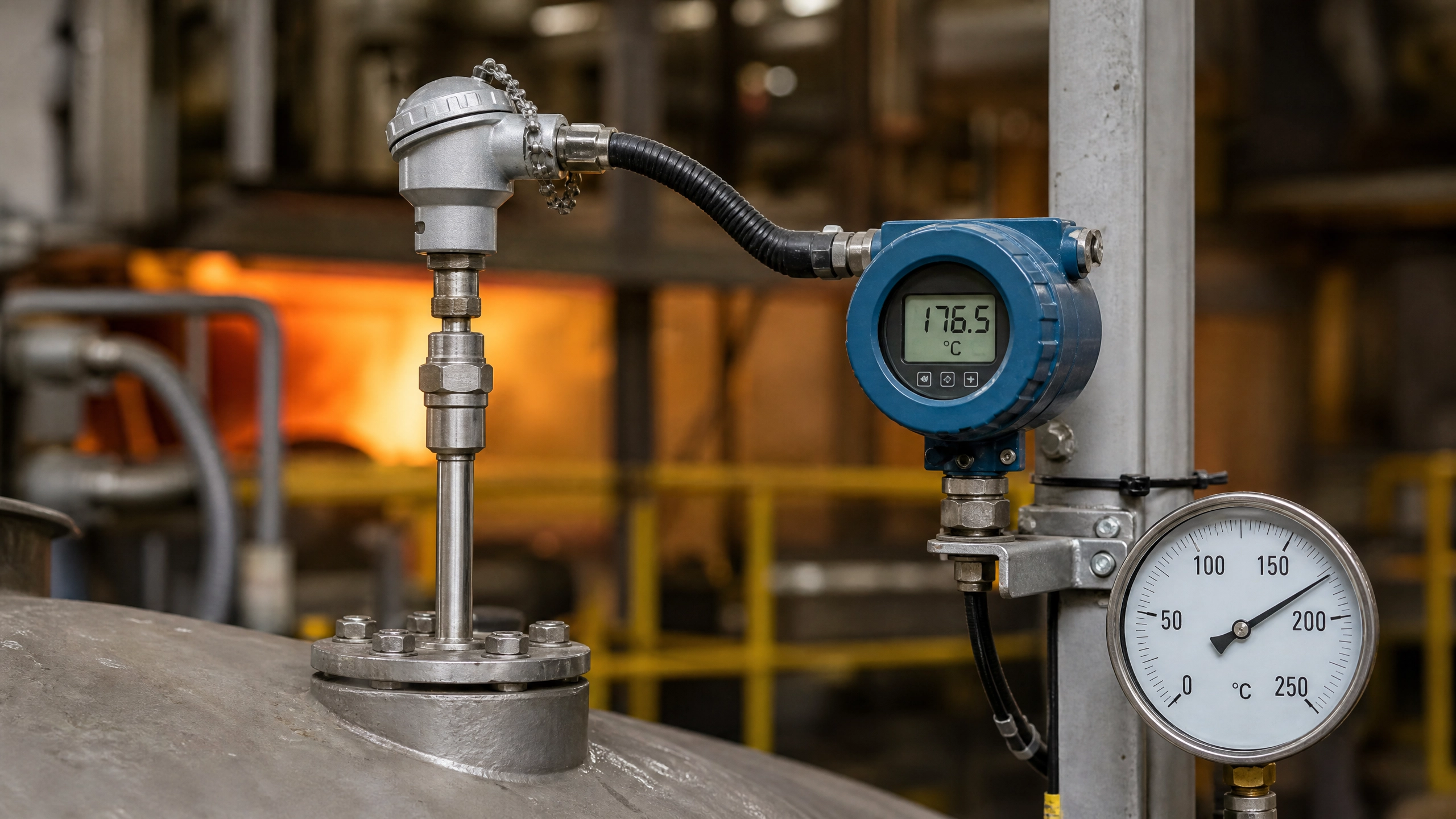
Figure 1: Industrial RTD Temperature Probe with 4-20 mA Transmitter in Process Vessel
The foundation of any temperature measurement system is the sensor itself. Several sensor types are compatible with 4-20 mA transmitters, each offering different characteristics suitable for specific applications.
Resistance Temperature Detectors (RTDs) provide excellent accuracy and stability. RTDs use the principle that electrical resistance changes with temperature. Platinum RTDs (Pt100, Pt1000) are most common, offering accuracy within ±0.1°C to ±0.5°C depending on grade. RTDs have excellent long-term stability and are suitable for precision applications in laboratories, pharmaceutical manufacturing, and food processing.
Thermocouples offer wider temperature ranges and faster response times than RTDs. A thermocouple consists of two dissimilar metals joined together, generating a small voltage proportional to temperature. Type K thermocouples (chromel-alumel) are most common, operating from -50°C to 1200°C. Type J thermocouples (iron-constantan) operate from -40°C to 750°C. Thermocouples are ideal for high-temperature applications like furnace monitoring and metal processing.
Thermistors, made from semiconductor materials, provide high sensitivity and fast response. Negative Temperature Coefficient (NTC) thermistors decrease resistance as temperature increases. They're commonly used in HVAC systems, refrigeration, and consumer electronics. However, thermistors have limited temperature ranges (typically -50°C to 150°C) and require individual calibration.
4-20 mA Temperature Transmitters
A temperature transmitter converts the sensor signal to a standardized 4-20 mA output. The transmitter includes signal conditioning circuitry, amplification, and conversion electronics. Most industrial temperature transmitters are two-wire devices, drawing power from the signal loop while outputting the 4-20 mA signal.
Temperature transmitters are configured with minimum and maximum temperature setpoints that define the 4-20 mA output range. For example, a transmitter might be configured for 0°C to 100°C, outputting 4 mA at 0°C and 20 mA at 100°C. Some transmitters offer adjustable ranges, allowing configuration for specific application requirements.
Accuracy specifications for industrial temperature transmitters typically range from ±0.5% to ±1.0% of the full scale. A transmitter configured for 0-100°C with ±0.5% accuracy maintains accuracy within ±0.5°C across the entire range. Response time, typically 100-500 milliseconds, depends on the sensor type and transmitter design.
Temperature Measurement in Chemical Processes
Chemical manufacturing requires precise temperature control to ensure product quality and safety. Consider a reactor where exothermic reactions must be maintained at 65°C ± 2°C. A temperature transmitter with a 0-100°C range outputs 4 mA at 0°C and 20 mA at 100°C.
The PLC reads the current value and converts it to temperature using the standard formula. If the temperature rises above 67°C, the PLC activates cooling systems. If it drops below 63°C, heating systems activate. The PLC continuously monitors the transmitter output, adjusting heating and cooling to maintain the setpoint.
The 4-20 mA signal's noise immunity is particularly valuable in chemical plants where numerous high-power equipment creates electromagnetic interference. The current-based signal remains stable despite the harsh electrical environment, ensuring reliable process control.
HVAC System Temperature Monitoring
Heating, ventilation, and air conditioning systems use multiple temperature sensors to optimize comfort and energy efficiency. A typical commercial HVAC system includes sensors for outdoor air temperature, indoor air temperature, supply air temperature, and return air temperature.
In a building with a central PLC controlling multiple zones, 4-20 mA temperature transmitters provide reliable measurements from each zone. A transmitter configured for -20°C to 50°C provides adequate range for most HVAC applications. The PLC reads all transmitters and adjusts dampers, fan speeds, and heating/cooling equipment to maintain setpoints in each zone.
The distributed nature of HVAC systems makes 4-20 mA signals particularly valuable. Sensors located hundreds of meters from the central control room can transmit accurate temperature data without signal degradation. The current-based signal maintains integrity through long cable runs that would degrade voltage-based signals.
Food and Beverage Processing
Food processing requires strict temperature control for both product quality and food safety. Pasteurization processes, for example, must maintain specific temperatures for specific durations to eliminate pathogens while preserving product quality.
A milk pasteurization system uses multiple temperature transmitters: one monitoring the incoming milk temperature, one monitoring the heating section, one monitoring the holding section, and one monitoring the cooling section. Each transmitter is configured for the appropriate range: perhaps -10°C to 80°C for the cooling section and 40°C to 100°C for the heating section.
The PLC monitors all transmitters and controls heating and cooling equipment to maintain the required temperature profile. If any temperature deviates from setpoint, the PLC can trigger alarms or automatically divert product to waste. The system maintains detailed records of all temperatures for food safety compliance and traceability.
Pharmaceutical Manufacturing
Pharmaceutical manufacturing demands exceptional accuracy and reliability in temperature measurement. Many processes require maintaining temperatures within ±1°C of setpoint. High-accuracy temperature transmitters with ±0.2% accuracy are often specified for these applications.
In a sterile manufacturing environment, transmitters are often mounted in hygienic housings that can be cleaned in place. The 4-20 mA signal transmits through the facility's control wiring to the central PLC. The PLC logs all temperature data, creating audit trails required by regulatory agencies.
Redundant temperature measurement is common in pharmaceutical applications. Two independent transmitters measure the same parameter, and the PLC compares their readings. If they diverge beyond a threshold, the system alerts operators to investigate potential problems.
Power Plant and Utility Applications
Power plants use temperature measurement throughout their operations: boiler outlet temperature, steam temperature, condenser cooling water temperature, and numerous other critical measurements. These measurements span wide ranges, from ambient temperature to several hundred degrees Celsius.
A coal-fired power plant might use a temperature transmitter configured for 0-400°C to monitor superheated steam temperature. The transmitter outputs 4 mA at 0°C and 20 mA at 400°C. The PLC reads this value and adjusts fuel flow to maintain optimal steam temperature for maximum efficiency.
The reliability of 4-20 mA signals is critical in utility applications where measurement failures can result in equipment damage or power outages. The current-based signal's inherent diagnostics (4 mA minimum) allow the system to detect broken wires or failed transmitters immediately.
Temperature Alarm Implementation
A practical PLC implementation includes temperature alarm logic. Consider a system monitoring a reactor temperature with a 0-100°C transmitter:
Plain Text
ORGANIZATION_BLOCK "TemperatureControl"
VAR
raw_count : INT;
temperature : REAL;
high_alarm : BOOL;
low_alarm : BOOL;
high_setpoint : REAL := 70.0;
low_setpoint : REAL := 60.0;
END_VAR;
END_ORGANIZATION_BLOCK
Conclusion
Temperature measurement using 4-20 mA transmitters provides reliable, accurate monitoring for diverse industrial applications. From chemical processes to HVAC systems, food processing to power plants, 4-20 mA temperature measurement remains the standard choice for critical temperature control. Understanding sensor types, transmitter configuration, PLC integration, and alarm implementation enables automation professionals to design and maintain effective temperature monitoring systems that ensure product quality, operational safety, and regulatory compliance.
Key Takeaways
•RTDs, thermocouples, and thermistors each offer different characteristics for temperature measurement
•Temperature transmitters convert sensor signals to standardized 4-20 mA outputs
•Transmitter configuration defines the temperature range corresponding to 4-20 mA
•PLC programs convert raw counts to temperature using standard formulas
•Alarm logic protects processes from temperature excursions
•4-20 mA signals provide reliable measurement in harsh industrial environments