In the rapidly evolving landscape of industrial automation, Programmable Logic Controllers (PLCs) have long been the backbone of manufacturing and process control. For decades, legacy PLCs have reliably managed countless operations, from simple machine sequencing to complex process orchestration. However, as technology advances and the demands of Industry 4.0 intensify, these older systems are increasingly becoming bottlenecks, hindering efficiency, connectivity, and future growth. The strategic migration from legacy PLCs to modern controllers is no longer a luxury but a critical imperative for businesses aiming to remain competitive and innovative.
This article will explore the compelling reasons behind this migration, the benefits offered by modern control systems, the challenges inherent in the transition, and best practices for executing a successful upgrade project.
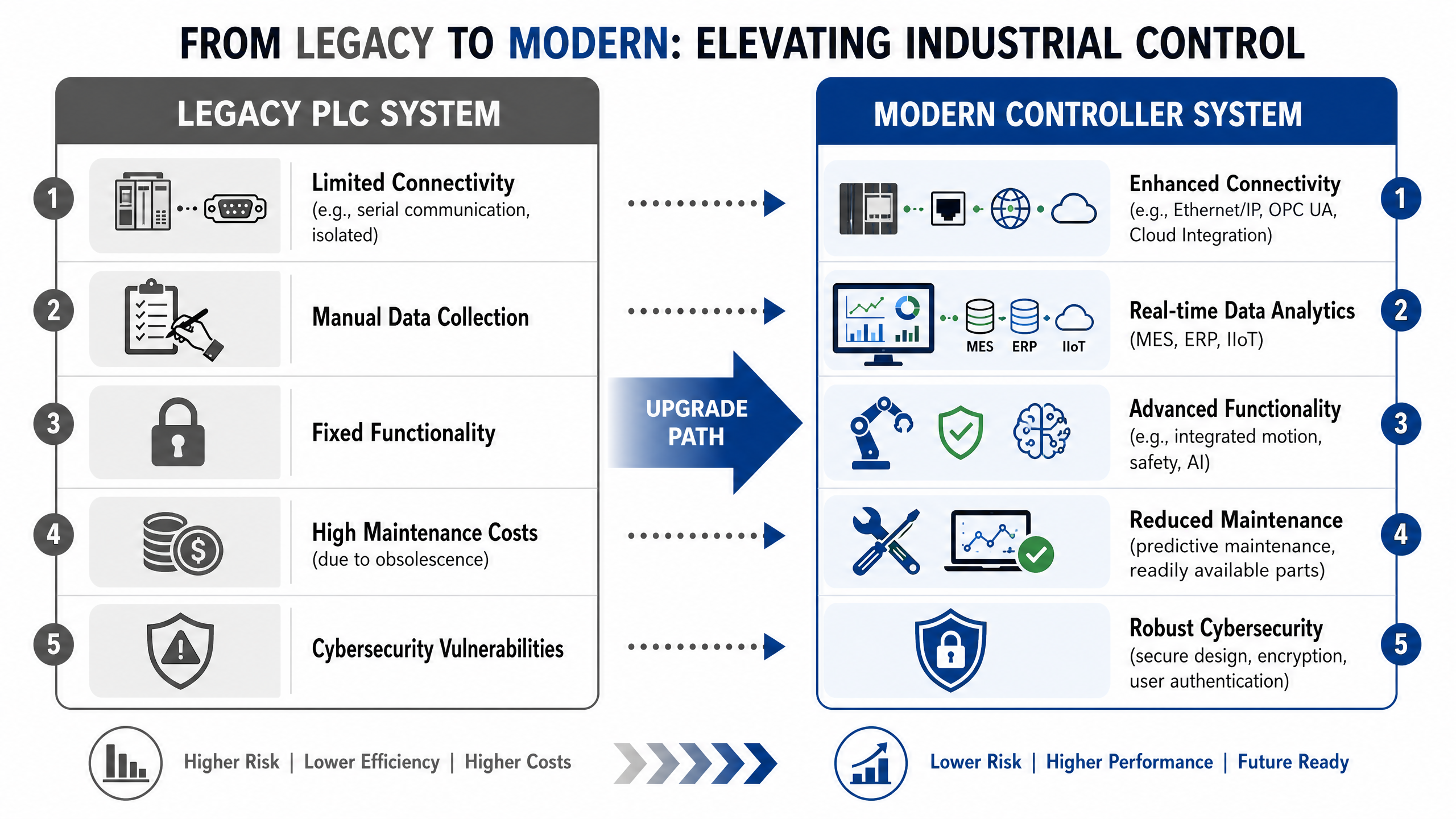
Several factors compel organizations to consider upgrading their legacy PLC infrastructure:
1. Obsolescence and Support Challenges
Legacy PLCs often rely on outdated hardware and software, making spare parts increasingly difficult and expensive to procure. Manufacturers eventually discontinue support for older product lines, leaving users vulnerable to extended downtime in case of failure. Finding skilled technicians proficient in programming and troubleshooting these older systems also becomes a significant challenge as the workforce ages and new talent is trained on modern platforms.
2. Limited Connectivity and Data Integration
Older PLCs were designed for a different era, with limited communication capabilities. They often lack native support for modern industrial communication protocols (e.g., Ethernet/IP, PROFINET, OPC UA) and struggle to integrate seamlessly with higher-level systems like Manufacturing Execution Systems (MES), Enterprise Resource Planning (ERP), and cloud-based analytics platforms. This isolation prevents real-time data acquisition, hindering data-driven decision-making and predictive maintenance initiatives.
3. Inadequate Processing Power and Memory
Modern industrial processes demand faster execution speeds, more complex algorithms, and larger data storage capacities. Legacy PLCs often have insufficient processing power and memory to handle these requirements, limiting the implementation of advanced control strategies, sophisticated diagnostics, and complex motion control.
4. Cybersecurity Vulnerabilities
Cybersecurity was not a primary concern during the design of many older PLC systems. They often lack robust security features, making them susceptible to modern cyber threats. Integrating them into networked environments without proper safeguards can expose entire operational technology (OT) networks to significant risks.
5. Lack of Advanced Functionality
Modern controllers offer a wealth of advanced features, including integrated motion control, advanced diagnostics, high-speed I/O, safety functions, and object-oriented programming environments. Legacy systems simply cannot provide these capabilities, limiting process optimization and the ability to implement new technologies.
The Transformative Benefits of Modern Controllers
Migrating to modern PLC platforms unlocks a wide array of advantages that directly contribute to operational excellence:
1. Enhanced Performance and Efficiency
Modern controllers boast significantly faster processors and larger memory capacities, enabling quicker scan times, more complex control algorithms, and improved system responsiveness. This translates to higher throughput, better product quality, and reduced cycle times.
2. Superior Connectivity and Data Analytics
With native support for standard industrial Ethernet protocols, modern PLCs facilitate seamless integration with other plant systems and the enterprise network. This enables real-time data collection, paving the way for advanced analytics, predictive maintenance, and the implementation of Industrial Internet of Things (IIoT) solutions. Data can be easily pushed to cloud platforms for deeper insights and remote monitoring.
3. Improved Maintainability and Support
Newer platforms come with comprehensive manufacturer support, readily available spare parts, and a larger pool of trained engineers. Diagnostic tools are more sophisticated, allowing for faster troubleshooting and reduced downtime. Modern programming environments are also more intuitive, reducing development and maintenance time.
4. Robust Cybersecurity Features
Designed with security in mind, modern controllers incorporate features like secure boot, encrypted communications, user authentication, and role-based access control. This significantly enhances the protection of critical infrastructure against cyber threats, aligning with contemporary cybersecurity best practices.
5. Future-Proofing and Scalability
Modern architectures are inherently more scalable and flexible, allowing for easier expansion and adaptation to future technological advancements and changing production demands. They provide a platform for implementing advanced control strategies, robotics, and artificial intelligence, ensuring the system remains relevant for years to come.
Challenges in PLC Migration
Despite the compelling benefits, PLC migration projects are complex and come with their own set of challenges:
•Downtime: The most significant concern is minimizing production downtime during the transition. Careful planning and phased approaches are crucial.
•Cost: Migration involves significant capital expenditure for new hardware, software licenses, engineering services, and training.
•Code Conversion: Converting existing ladder logic or other programming languages from legacy systems to modern platforms can be time-consuming and prone to errors. Thorough testing is essential.
•Interoperability: Ensuring seamless communication and data exchange between new controllers and existing field devices, HMI/SCADA systems, and enterprise software can be complex.
•Risk Management: Identifying and mitigating potential risks, such as unexpected system behavior, data loss, or compatibility issues, requires meticulous planning.
Best Practices for a Successful Migration
To navigate these challenges and ensure a smooth transition, consider the following best practices:
1.Comprehensive Assessment: Begin with a thorough audit of the existing system, documenting all hardware, software, network configurations, and control logic. Identify critical processes and potential risks.
2.Phased Approach: Instead of a complete rip-and-replace, consider a phased migration. This could involve upgrading non-critical sections first, or running new and old systems in parallel for a period.
3.Standardization: Use the migration as an opportunity to standardize on a modern control platform and programming practices across the facility.
4.Detailed Planning and Design: Develop a detailed project plan, including scope, budget, timeline, resource allocation, and a comprehensive testing strategy. Design the new system with scalability and future expansion in mind.
5.Data Backup and Recovery: Implement robust data backup and recovery procedures for both legacy and new systems. Ensure all program logic, configuration files, and historical data are securely stored.
6.Thorough Testing: Conduct extensive testing, including factory acceptance testing (FAT) and site acceptance testing (SAT), to validate functionality, performance, and integration before full deployment.
7.Training: Invest in comprehensive training for operators, maintenance personnel, and engineers on the new hardware, software, and programming environment.
8.Vendor Partnership: Collaborate closely with experienced system integrators and the chosen PLC vendor. Their expertise can be invaluable in navigating complex technical challenges.
Conclusion
The migration from legacy PLCs to modern controllers is a strategic investment that offers substantial returns in terms of improved performance, enhanced connectivity, increased cybersecurity, and long-term sustainability. While the process presents challenges, a well-planned and meticulously executed migration, guided by best practices, can transform industrial operations, positioning businesses for success in the era of smart manufacturing. Embracing modern control technology is not just about replacing old equipment; it's about building a resilient, intelligent, and efficient foundation for the future of industrial automation.
1 comment:
This blog offers great guidance for industry professionals.
Industrial MLSS Analyzer Supplier
Post a Comment