Showing posts with label Pneumatic & Electropneumatic. Show all posts

Pneumatic Cylinder Flow Control: Meter-In vs. Meter-Out


Pneumatic Cylinder Flow Control: Meter-In vs. Meter-Out

Introduction

Pneumatic cylinders are essential components in industrial automation systems, widely used for tasks such as lifting, pushing, clamping, and positioning. Their simplicity, reliability, and cost-effectiveness make them a preferred choice in manufacturing, packaging, and assembly lines. However, the performance and safety of pneumatic systems heavily depend on proper flow control. Incorrect application of flow control can lead to jerky movements, pressure spikes, premature seal wear, and even safety hazards for operators. Understanding the principles of flow control, particularly the Meter-In and Meter-Out strategies, is crucial for ensuring smooth and safe cylinder operation.


Basics of Pneumatic Flow Control

Pneumatic cylinders operate by using compressed air to move a piston within a cylinder. Air enters one side of the piston while the other side exhausts air, creating motion. The speed and behavior of this motion are influenced by how the airflow is controlled. Flow control valves are used to regulate either the inlet (air entering the cylinder) or the exhaust (air leaving the cylinder). Controlling the inlet airflow is known as Meter-In control, while controlling the exhaust airflow is referred to as Meter-Out control.


Meter-In Flow Control

Meter-In flow control regulates the amount of air entering the cylinder. The flow control valve is placed on the supply side of the cylinder port. By restricting the inlet airflow, the piston speed is controlled while the exhaust air exits freely. This method is best suited for applications where the load resists motion, such as pushing against a heavy object.

Example Scenario: A horizontal cylinder pushing a heavy object on a conveyor. The object resists motion due to friction. Using Meter-In control ensures smooth extension without overshooting.

Risks if Misapplied: If used when the load assists motion (e.g., gravity pulling the piston), the cylinder may accelerate uncontrollably, leading to unsafe conditions.


Meter-Out Flow Control

Meter-Out flow control regulates the exhaust air leaving the cylinder. The valve is placed on the outlet side of the cylinder port. By restricting the exhaust, the piston speed is controlled while the inlet air flows freely. This method is ideal for applications where the load assists motion, such as gravity pulling the piston downward.

Example Scenario: A vertical cylinder lowering a heavy load. Gravity assists the motion, and without control, the piston would drop suddenly. Meter-Out ensures the exhaust air escapes slowly, allowing smooth and safe lowering.

Risks if Misapplied: If used with resisting loads, the cylinder may stall or jerk due to unnecessary back pressure.

Comparison Table

Flow Control

What It Controls

Best Use Case

Risk if Misapplied

Meter-In

Inlet airflow

Resisting loads, controlled push

Load may run away if assisting force present

Meter-Out

Exhaust airflow

Assisting loads, gravity effects

Cylinder may jerk or stall if resisting load


Engineering Insight

Both Meter-In and Meter-Out strategies are valid, but their effectiveness depends on the application scenario. An experienced engineer understands when to apply each method based on load behavior and motion direction. This level of understanding distinguishes a technician, who may follow standard procedures, from an engineer who designs systems for optimal performance and safety.

Practical Examples

Horizontal Cylinder Pushing Load: Use Meter-In to control extension speed against frictional resistance.


Vertical Cylinder Lowering Load: Use Meter-Out to prevent sudden drops due to gravity.


Clamping Application: Use Meter-In to ensure controlled approach and avoid damaging the workpiece.


Training Importance

Teaching flow control strategies early in engineering education is essential. It helps students understand the relationship between airflow, load behavior, and motion control. Hands-on lab exercises using pneumatic trainers can vividly demonstrate the effects of Meter-In and Meter-Out configurations. Such practical exposure reinforces theoretical knowledge and prepares students for real-world applications.

Advanced Considerations

Double-Acting Cylinders: Require careful selection of flow control for both extension and retraction strokes.


Hydraulic Parallels: Similar principles apply, but fluid incompressibility changes system response.


Combination Control: Some systems use both Meter-In and Meter-Out for fine-tuned performance.


Energy Efficiency: Proper flow control reduces air consumption and improves system efficiency.


Conclusion

Pneumatic cylinder flow control is a fundamental concept in automation engineering. Choosing between Meter-In and Meter-Out strategies requires understanding the nature of the load and the desired motion behavior. Correct application ensures smooth operation, longer equipment life, and safer working conditions. For students and professionals alike, mastering these principles is key to designing efficient and reliable pneumatic systems.


Double acting pneumatic cylinder operation using 5/2 direction control valve and PLC

 Problem Statement: -

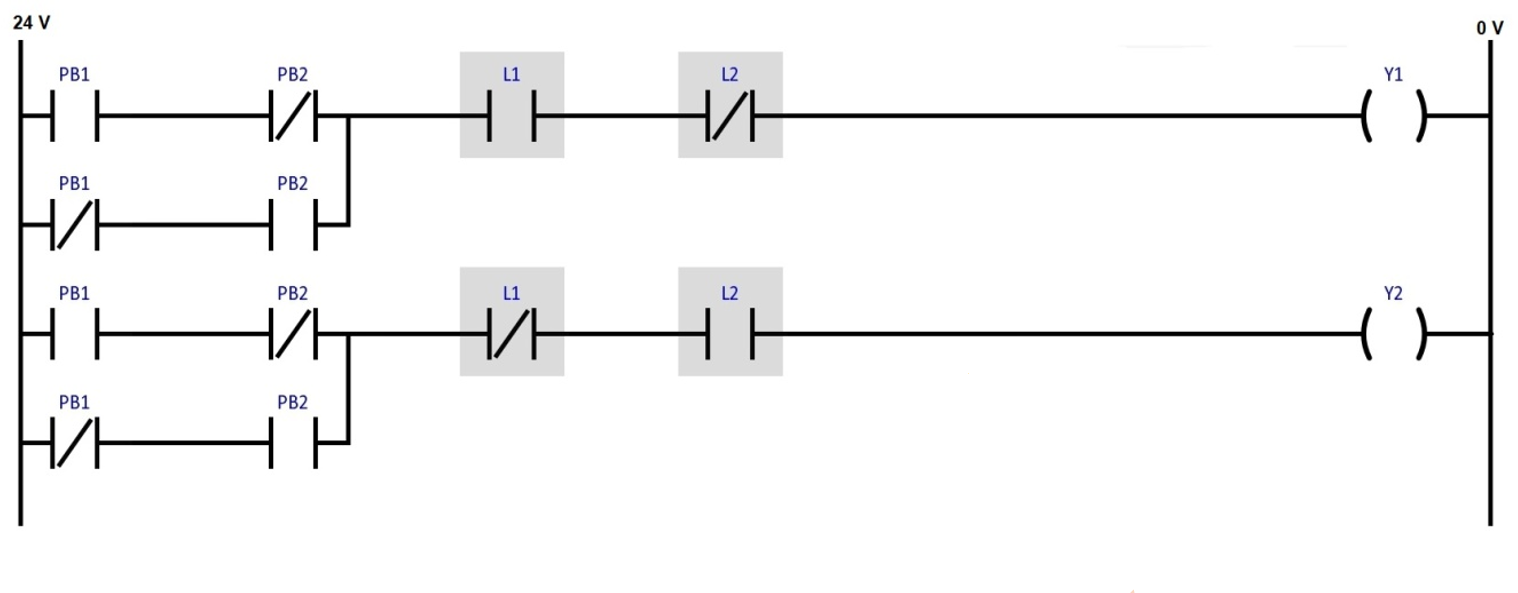
A heavy door is to be opened or closed by a double-acting cylinder. This door will open or close with two push buttons, one push button is located inside and another push button is located outside. Draw a Ladder Diagram for the Giving Condition.

a) The push button should only work when the door is either fully open or fully closed.


Solution: -

Number of inputs = 4

PB1: Inside push button

PB2: Outside push button

L1:  Limit switch located at closing position.

L2:  Limit switch located at open position.


Number of outputs = 2

Y1: Left Solenoid of 5/2 control valve

Y2: Right Solenoid of 5/2 control valve

Pneumatic Circuit Diagram:


Answer - (a): -

 Number of inputs = 4

Possibilities = 24 =16


Description: -

Initially, as the door is fully closed the L1 limit switch is pressed (L1=1 & L2=0), the door will only open when any one of the push buttons is pressed (PB1 =1 & PB2=0 OR PB1=0 & PB2=1)

It is not possible that both the Limit switches L1 & L2 are pressed at the same time   (L1=1 & L2=1).

Both the switches are unpressed (L1=0 & L2=0), which means the door is neither fully opened nor fully closed

As the door is fully closed the L1 limit switch is pressed (L1=0 & L2=1), the door will only open when any one of the push buttons is pressed (PB1 =1 & PB2=0 OR PB1=0 & PB2=1).

Hence, Y1= (L1) (L2)’ (PB1)’ (PB2) + (L1) (L2)’ (PB1) (PB2)’

               = (L1) (L2)’ [(PB1)’ (PB2) + (PB1) (PB2)’]


             Y2= (L1)’ (L2) (PB1)’ (PB2) + (L1)’ (L2) (PB1) (PB2)’

               = (L1)’ (L2) [(PB1)’ (PB2) + (PB1) (PB2)’]


Note: - Above application may be different from actual application. This example is only for explanation purpose only. We can use this concept in other examples also. All parameters and graphical representations considered in this example are for explanation purpose only, parameters or representation may be different in actual applications. Also, all interlocks are not considered in the application.


                                                                                            Written by Subham Prajapati


Air Generation system of Pneumatic System                                                    

Air generation and distribution

It supplies compressed air which is clean, dry, and at required pressure

The compressed air is produced by an air compressor

Air service unit is used to improve the quality of air before use

Proper air preparation reduces system faults and improves performance


Main parts in the compressed air preparation

Air compressor

Air tank (Reservoir)

Air filter

Cooling and drying unit

Shut off valve

Piping

Air Service unit

Pressure regulator

Air lubricator

Manifold

Tubes and fittings

Pressure Gauge


Air compressor

An air compressor is used to produce compressed air for the system with the required volume and pressure

Most pneumatic components are designed to operate at a maximum pressure of 8–10 bar

For safe and economical operation, the recommended working pressure is between 5–6 bar

Due to pressure losses in the air distribution system, the compressor should supply air at about 6.5–7 bar                               


illustration of a compressor system showing air intake filter, compressor unit, motor drive, cooling system, receiver tank, pressure switch, safety valve, drain valve, and distribution line


Air Tank (reservoir)

An air reservoir should be fitted to

Store and stabilize the compressed air.

Compensate the pressure fluctuation.

Cool the air.

illustration of a receiver tank used in a pneumatic system, showing air inlet, pressure gauge, safety valve, drain valve, and outlet to distribution line


Air Filter

A compressed air filter is used to remove dirt, contaminants, and condensed water from compressed air

The compressed air enters the filter bowl through guide slots

Liquid particles and large dust particles are separated by centrifugal action and collect at the bottom of the filter bowl

The collected condensate must be drained before it reaches the maximum level, otherwise it may mix again with the air


illustration of an air filter used in a pneumatic system, showing filter housing, inlet and outlet ports, and internal filtering element


Cooling and drying unit

The air coming out of the compressor is very hot and humid

The cooling and drying unit is used to reduce the air temperature and remove water vapor from the compressed air

The amount of Condense water formed depends on the relative humidity of air, which is affected by temperature and weather conditions

To remove humidity, different types of air dryers are used, and the most common method is a cooling unit that cools the air and removes moisture at the same time


illustration of a cooling and drying unit used in a pneumatic system, showing air inlet, heat exchanger or aftercooler, moisture separator, desiccant dryer, and air outlet


Shut off valve

It is used to open and close the compressed air supply manually


diagram of a shut-off valve used in pneumatic systems, showing valve body, inlet and outlet ports, and handle indicating open and closed positions


Piping

The pipe diameter of the air distribution system should be chosen so that the pressure loss from the air reservoir to the consuming device does not exceed about 0.1 bar (10 k Pa).

Ring circuits are used as main lines to ensure continuous air supply during high air consumption

Pipelines are laid in the direction of air flow with a slope of 1–2%

Condensed water is removed from the lowest points of the pipelines

Branch connections are taken from the top of the main line to prevent moisture entry

Shut-off valves are used to close air lines during maintenance or when not in use

 diagram of pneumatic piping system showing air filter, regulator, lubricator, receiver tank, shut-off valve, distribution lines, and actuator connections

 Air service unit

The main function of the service unit

is to provide the pneumatic system

with a well cleaned, lubricated and

regulated compressed air


diagram of an FRL unit (Filter, Regulator, Lubricator) used in pneumatic systems, showing labeled components with Calibri font: air inlet, air filter, pressure regulator, lubricator, and air outlet

Pressure regulator

The purpose of the regulator is to reduce or control the pressure in the pneumatic system

It keeps the system operating pressure secondary pressure nearly constant, even if the line pressure primary pressure or air consumption change

Air lubricator

Moving parts like cylinders, valves, and air motors need lubrication to work better

Air lubricator adds oil in tiny droplets (aerosol) into the compressed air

The air carries the oil to the tools or cylinders so they run smoothly


Manifold (distributor)

Used to provide multiple outlets at equal pressure

Each output port has a check valve (non-return valve) to prevent back-flow


Tubes and fittings

Different types of tubes are used to connect pneumatic circuit.Important fittings like T connections and cross connections help join tubes and split or change air flow

Tubes are usually made of PVC, nylon, or polyurethane for flexibility and strength

Proper tubes and fittings prevent air leakage and ensure smooth operation

Tubes should be cut cleanly and connected tightly to avoid pressure loss


Pressure gauge

It used to display the actual amount of the pressure in two main units PSI and bar

diagram of a pressure gauge used in pneumatic systems, showing circular dial, needle indicator, pressure scale, and connection port, with labels in Calibri font