May 26, 2026

4-20 mA Integration with PLC Analog Input Modules

Successfully integrating 4-20 mA sensors and transmitters with programmable logic controllers requires understanding both the hardware connections and the software configuration. PLC analog input modules serve as the interface between the analog 4-20 mA signal world and the digital PLC environment.

PLC Integration Architecture

4-20 mA Signal Path from Transmitter to PLC Processing

This article explores the practical aspects of hardware integration, module selection, configuration, and troubleshooting of 4-20 mA inputs in PLC systems.

PLC Analog Input Module Architecture

Siemens S7-1200 PLC with Analog Input Module
Siemens S7-1200 PLC with Analog Input Module and 4-20 mA Signal Connections

A typical PLC analog input module contains several key components: terminal blocks for signal connections, signal conditioning circuitry, analog-to-digital converters (ADCs), and communication interfaces. The signal conditioning stage includes the precision resistor (usually 250 ohms) that converts the 4-20 mA current to a 1-5 volt signal. This voltage is then amplified and filtered to remove noise before being converted to digital counts by the ADC.

Most modern PLC analog input modules use 12-bit or 16-bit ADCs. A 12-bit ADC produces values from 0 to 4095 counts, while a 16-bit ADC produces values from 0 to 65535 counts. The higher resolution of 16-bit modules provides better accuracy and finer resolution, making them preferable for applications requiring high precision.

Hardware Connection Considerations

Proper physical connection of 4-20 mA signals to PLC input modules is critical for reliable operation. Each analog input channel typically has three terminals: positive signal input, negative signal return (common), and shield ground. The 4-20 mA signal flows from the transmitter through the positive terminal, through the precision resistor in the input module, and returns through the common terminal.
The shield ground connection deserves special attention. The shielded cable used for 4-20 mA signals should have its shield connected to the shield ground terminal at the PLC module. This connection provides a return path for electromagnetic interference, significantly improving noise immunity. The shield should be connected at only one end—typically at the PLC module end—to prevent ground loops that can introduce noise into the signal.

Cable selection significantly impacts signal quality. Industrial-grade twisted-pair shielded cable is standard for 4-20 mA signals. The twisted pair geometry helps cancel electromagnetic interference, while the shield provides additional protection. Cable impedance should be less than 100 ohms per kilometer. For long cable runs (over 500 meters), low-impedance cable becomes increasingly important.

Transmitter Power Supply Considerations

4-20 mA transmitters require power to operate. Two-wire transmitters draw their power from the signal loop itself, while three-wire and four-wire transmitters have separate power connections. Understanding the transmitter power requirements is essential for proper system design.
Two-wire transmitters are the most economical, using only two wires for both power and signal. The loop power supply must provide sufficient voltage to overcome the voltage drops across the transmitter, cable, and input module resistor. A typical 24 VDC power supply is standard, providing adequate voltage for most installations. The power supply must also include current limiting to protect the circuit from short circuits.

Three-wire transmitters use one wire for power supply common, one for signal positive, and one for signal negative. Four-wire transmitters have completely separate power and signal circuits, providing the best performance but requiring more wiring. The choice between these configurations depends on application requirements, budget, and available infrastructure.

PLC Module Configuration

Configuring the PLC analog input module involves several steps. First, the module must be physically installed in the PLC chassis and properly seated to ensure good electrical contact. Second, the module must be recognized by the PLC system software and assigned to the appropriate I/O address space. Third, the module parameters must be configured to match the signal characteristics.

Key configuration parameters include the input range (typically 4-20 mA or 0-10 V), the number of active channels, the sampling rate, and the filter settings. The input range configuration tells the module how to scale the raw ADC counts to engineering units. Most modules allow selection between different standard ranges or custom ranges.

The sampling rate determines how frequently the module reads the analog input. Typical sampling rates range from 10 to 1000 samples per second. Higher sampling rates provide faster response but increase computational load. For most industrial applications, 100 samples per second provides adequate response while maintaining reasonable performance.

Filter settings reduce noise in the analog signal. Most modules offer selectable filters with different time constants. A first-order low-pass filter with a 100-millisecond time constant is typical for industrial applications. Faster filters provide better response but may not adequately suppress high-frequency noise. Slower filters provide better noise suppression but may cause lag in signal response.

Software Implementation in SCL

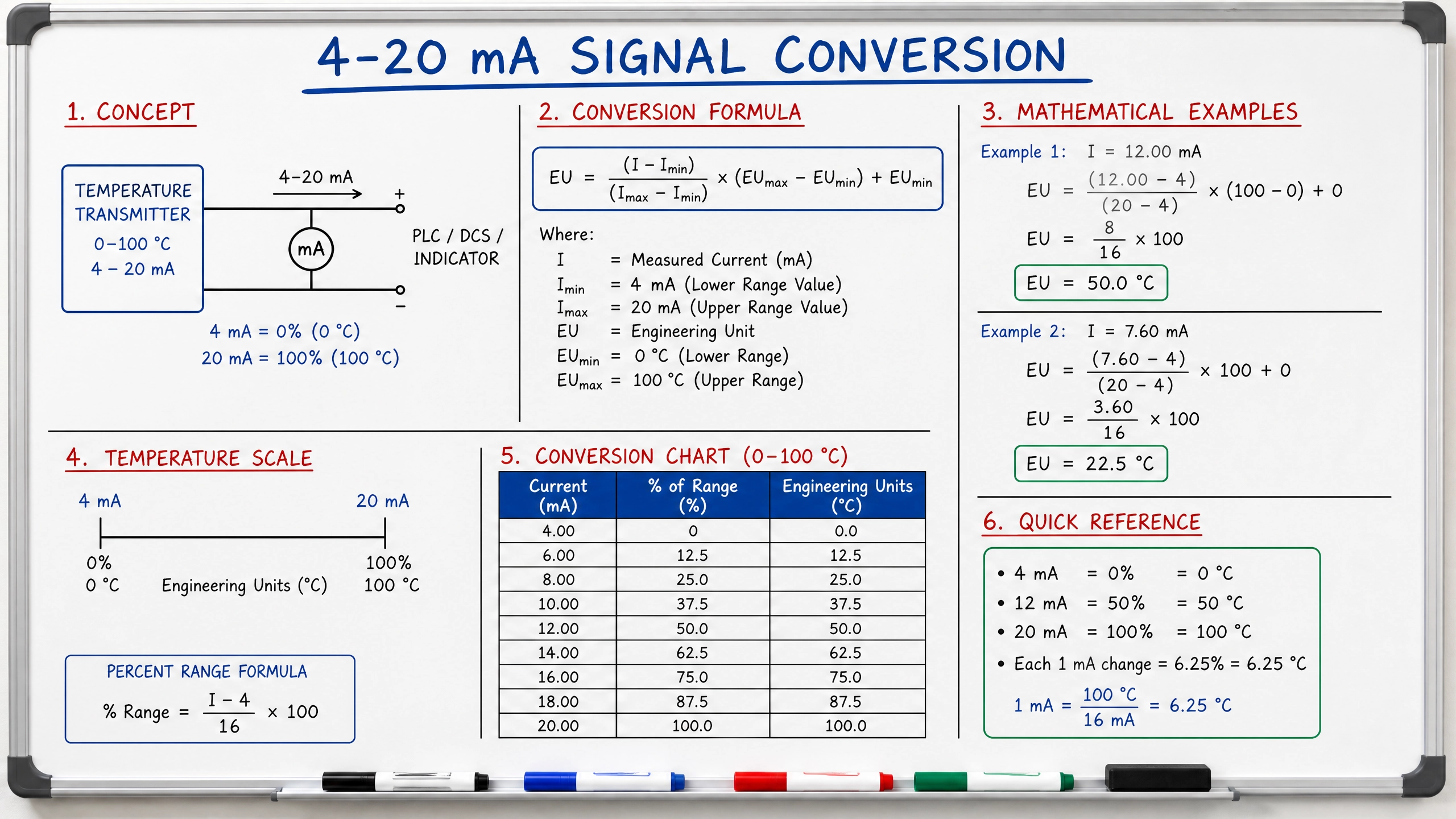
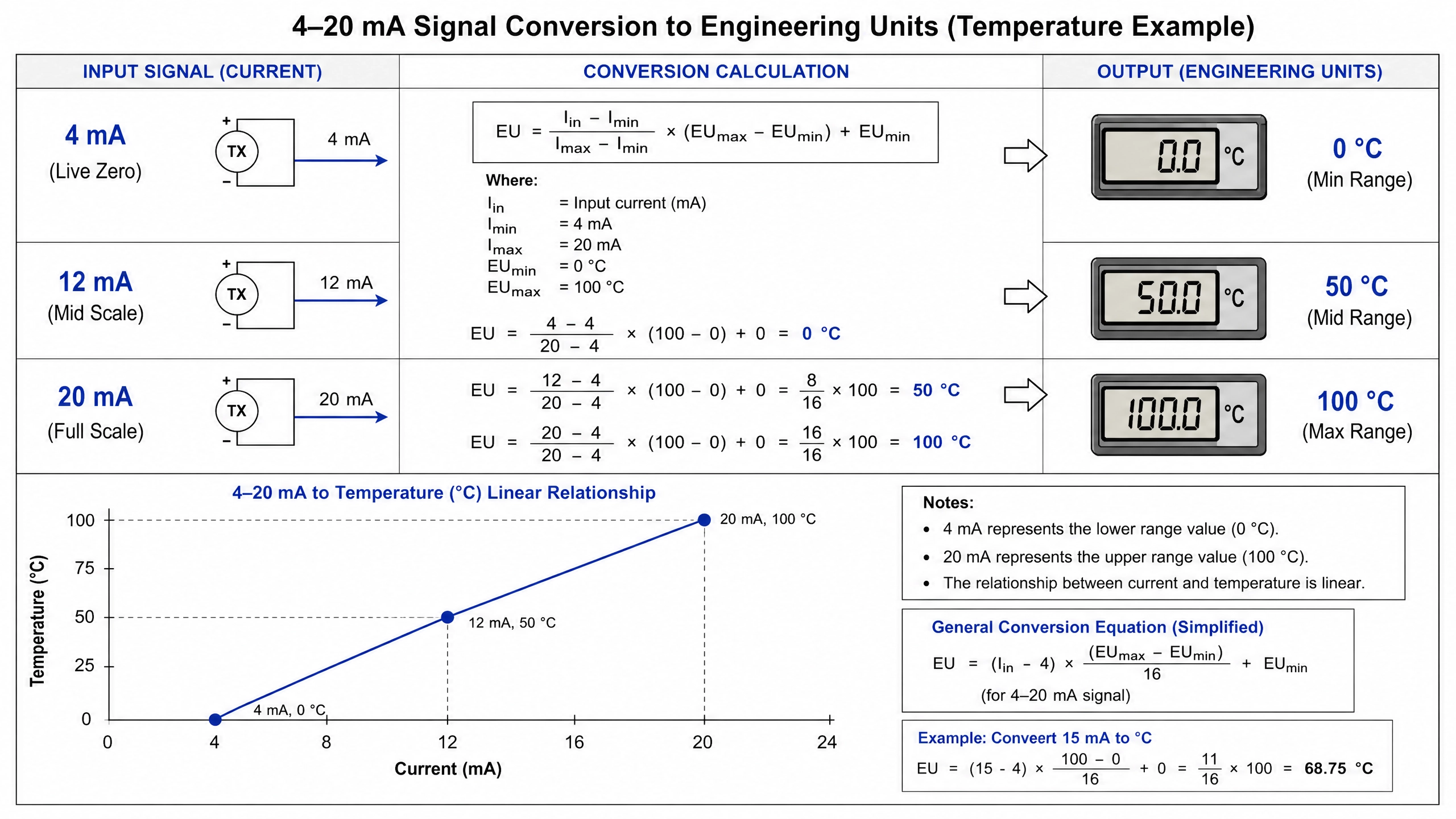
In Siemens TIA Portal using SCL, reading 4-20 mA analog inputs involves accessing the analog input data from the module and applying the appropriate conversion calculations. The PLC automatically converts the analog signal to digital counts, but the programmer must convert these counts to engineering units.
A typical SCL implementation looks like:
ORGANIZATION_BLOCK "AnalogInput"
VERSION : 0.1

VAR raw_count : INT; // Raw ADC count from module current_mA : REAL; // Calculated current in mA temperature : REAL; // Temperature in degrees C min_temp : REAL := 0.0; // Minimum temperature max_temp : REAL := 100.0; // Maximum temperature END_VAR; BEGIN // Read raw count from analog input module (channel 0) raw_count := INT(AI[0]); // Convert count to current (12-bit ADC: 819 counts = 4mA, 4095 = 20mA) current_mA := (raw_count - 819) / 3276 * 16 + 4; // Convert current to temperature temperature := (current_mA - 4) / 16 * (max_temp - min_temp) + min_temp;
END_ORGANIZATION_BLOCK

Calibration and Verification

After installation and configuration, the system must be calibrated to ensure accurate measurements. Calibration involves comparing the PLC reading with a known reference value and adjusting the conversion parameters if necessary.

A typical calibration procedure involves applying known current values to the input and recording the corresponding PLC readings. At minimum, calibrate at two points: 4 mA (0% of range) and 20 mA (100% of range). For higher accuracy, calibrate at three or more points across the measurement range.
If the readings don't match the expected values, the offset and scale parameters should be adjusted. Offset adjusts the zero point of the measurement, while scale adjusts the full-scale reading. Most PLC systems provide easy methods to adjust these parameters without modifying the core program logic.

Troubleshooting Common Issues

Several common problems can occur with 4-20 mA input integration. If the PLC reads a constant value regardless of transmitter output, the signal connection is likely broken or the module is not properly configured. If the reading fluctuates wildly, inadequate filtering or poor cable shielding is usually the cause.

If the reading is consistently offset from the expected value, calibration adjustment is needed. If the reading is scaled incorrectly (for example, showing double the expected value), the scaling parameter needs adjustment. If the reading occasionally drops to zero, a loose connection or intermittent break in the signal cable is likely.

Redundancy and Diagnostics

Modern PLC systems often include redundancy features for critical measurements. Dual analog input modules reading the same transmitter provide backup if one module fails. The PLC can compare the two readings and alert the operator if they diverge beyond a threshold, indicating a potential problem.
Diagnostic features in the analog input module can detect various fault conditions: open circuit (broken wire), short circuit, out-of-range signal, and module hardware failures. These diagnostics are typically reported through status registers that the PLC program can monitor.

Conclusion

Successful integration of 4-20 mA signals with PLC analog input modules requires attention to hardware connections, proper module configuration, accurate software implementation, and thorough testing. Understanding the signal path from transmitter through input module to PLC memory, combined with knowledge of configuration options and troubleshooting techniques, enables automation professionals to build reliable measurement systems. Whether implementing temperature monitoring, pressure control, or flow measurement, mastering these integration techniques is essential for effective industrial automation.

Key Takeaways

Analog input modules convert 4-20 mA signals to digital counts using precision resistors and ADCs
Proper cable selection and shielding significantly impact signal quality
Configuration parameters must match the transmitter and application requirements
SCL programs must convert raw counts to engineering units using appropriate formulas
Calibration at multiple points ensures accurate measurements
Diagnostic features help identify and troubleshoot connection and hardware problems

May 25, 2026

4-20 mA Signal Conditioning: Noise Immunity and Signal Quality

While 4-20 mA signals offer superior noise immunity compared to voltage-based signals, industrial environments present numerous challenges that can degrade signal quality. Electromagnetic interference from motors, drives, and power lines; ground loops; and cable impedance issues can all affect measurement accuracy. This article explores signal conditioning techniques, noise sources, grounding strategies, and practical methods to ensure reliable 4-20 mA signal transmission in harsh industrial environments.

Control Cabinet with Signal Conditioning
Figure 1: Industrial Control Cabinet with Shielded Cables and Signal Conditioning Equipment

Sources of Noise in Industrial Environments

Industrial facilities contain numerous sources of electromagnetic interference. Variable frequency drives (VFDs) controlling motor speeds generate high-frequency switching noise. Welding equipment creates intense electromagnetic fields. High-voltage power lines and transformers generate 50/60 Hz and harmonic interference. Radio transmitters and cellular systems introduce RF interference. Understanding these noise sources is the first step in mitigating their effects.

Conducted noise enters the signal circuit through power supply lines or ground connections. Common-mode noise appears equally on both signal conductors, while differential-mode noise appears between them. The 4-20 mA current loop is particularly immune to common-mode noise because the signal is defined by current flow through the loop, not voltage referenced to ground.

Radiated noise couples into signal cables through electromagnetic induction. Cables located near high-current conductors or high-voltage equipment experience stronger coupling. The twisted-pair geometry of industrial signal cables provides some immunity by canceling induced voltages, but additional shielding is often necessary in severe environments.

Cable Selection and Routing

Proper cable selection is fundamental to signal quality. Industrial-grade twisted-pair shielded cable is standard for 4-20 mA signals. The twisted-pair geometry ensures that any electromagnetic field induces equal voltages in both conductors, which cancel each other in the differential signal. The shield provides additional protection by intercepting radiated noise.

Cable impedance affects signal quality, particularly for long runs. Low-impedance cable (less than 100 ohms per kilometer) maintains signal integrity better than high-impedance cable. For runs exceeding 500 meters, low-impedance cable becomes increasingly important.


Cable routing significantly impacts noise coupling. Signal cables should be routed away from high-current power cables, motor leads, and VFD output cables. When crossing power cables is unavoidable, the crossing should be at right angles to minimize coupling. Keeping signal cables at least 30 centimeters from power cables is a practical guideline.

Separating signal cables from power cables in different conduits or cable trays provides better isolation than mixing them. In severe environments, running signal cables through separate shielded conduit can be justified. Some facilities use fiber optic cables for critical measurements to provide complete electrical isolation.

Shielding and Grounding

The shield in shielded cable must be properly grounded to be effective. The shield should be connected to the shield ground terminal at the PLC analog input module. At the transmitter end, the shield should typically be grounded to the transmitter chassis.

A critical principle: the shield should be grounded at only one point to prevent ground loops. If the shield is grounded at both ends, current can flow through the shield, creating a ground loop that introduces noise. The single-point grounding principle is particularly important in systems with multiple transmitters and long cable runs.

In some cases, the transmitter location may be far from the PLC, and the transmitter may be grounded to local earth ground. In these situations, the shield should be grounded at the transmitter end only, with the shield floating (ungrounded) at the PLC end. This prevents ground loop current from flowing through the shield.

Filtering and Signal Conditioning

Analog input modules typically include built-in filtering to reduce noise. A first-order low-pass filter with a 100-millisecond time constant is common. This filter removes high-frequency noise while allowing the signal to respond to actual process changes.

The filter time constant must be chosen carefully. A faster filter (shorter time constant) provides better response to process changes but less noise filtering. A slower filter provides better noise filtering but slower response. For most industrial applications, a 100-200 millisecond time constant provides a good balance.

Some applications benefit from additional external filtering. An RC filter (resistor-capacitor network) can be added between the transmitter and the PLC input to provide additional noise filtering. The filter should be designed to have minimal effect on the signal while effectively attenuating high-frequency noise.

Ferrite Clamps and Shielding

Ferrite clamps placed around signal cables provide additional noise immunity. Ferrite material absorbs high-frequency electromagnetic energy, preventing it from coupling into the signal conductors. Ferrite clamps are particularly effective for RF interference from radio transmitters and cellular systems.

Ferrite clamps should be placed as close as possible to the noise source. For a VFD output cable, placing ferrite clamps on the cable near the VFD is more effective than placing them near the motor. For signal cables, ferrite clamps should be placed at both the transmitter and PLC ends.

In severe electromagnetic environments, ferrite shielding boxes can be constructed around sensitive equipment. The transmitter or PLC input module can be placed inside a ferrite-lined enclosure, providing comprehensive shielding from external electromagnetic fields.

Isolation and Optocoupling

In some cases, complete electrical isolation between the transmitter and PLC is necessary. Isolation transformers can be used in power supply circuits to break ground loops. For signal transmission, optocoupling (using light-emitting diodes and photodiodes) provides complete electrical isolation while transmitting the signal.
Isolated 4-20 mA repeaters are available that accept a 4-20 mA input and output a new 4-20 mA signal that is electrically isolated from the input. These devices are useful for breaking ground loops in multi-transmitter systems where ground loop current would otherwise flow through the signal circuit.

Grounding Practices

Proper grounding is essential for noise immunity. The PLC enclosure should have a solid ground connection to the facility earth ground. This ground should be a low-impedance path, typically using a large copper conductor or bus bar.

Signal ground should be connected to the same ground point as power ground, but through a separate conductor to avoid coupling noise from power currents into the signal ground. In large facilities, a star grounding pattern (all grounds connected at a single point) provides better noise immunity than daisy-chain grounding.

Ground loops occur when multiple paths exist between ground points at different potentials. In a multi-transmitter system, if each transmitter is grounded to local earth ground and the PLC is grounded to a different earth ground location, ground loop current flows through the signal circuit. Careful grounding design prevents these loops.

Practical Noise Troubleshooting

When noise problems occur, systematic troubleshooting identifies the source. First, verify that the signal cable is properly shielded and grounded. Second, check that the cable is routed away from power cables. Third, verify that the PLC input module filter settings are appropriate.

If noise persists, try adding ferrite clamps to the signal cable. If noise is still present, try routing the signal cable through separate conduit away from power cables. If the problem continues, consider using an isolated 4-20 mA repeater to break ground loops.

Measurement Verification

After implementing noise reduction measures, verify that signal quality has improved. Use an oscilloscope to observe the signal voltage across the input resistor. The signal should be relatively smooth with minimal high-frequency noise. If the signal shows significant noise, additional filtering or shielding is needed.

Compare PLC readings before and after implementing noise reduction measures. Readings should be more stable and consistent. If readings still fluctuate, additional measures are necessary.

Conclusion

Maintaining signal quality in 4-20 mA systems requires attention to cable selection, routing, shielding, grounding, and filtering. While 4-20 mA signals offer inherent noise immunity compared to voltage signals, industrial environments present challenges that can degrade signal quality. Understanding noise sources, implementing proper grounding practices, using appropriate filtering, and applying shielding techniques ensures reliable signal transmission. Automation professionals who master these signal conditioning techniques can design robust measurement systems that maintain accuracy even in harsh electromagnetic environments.

Key Takeaways

Industrial environments contain numerous sources of electromagnetic interference
Twisted-pair shielded cable provides basic noise immunity
Shield grounding at a single point prevents ground loops
Filtering removes high-frequency noise while preserving signal response
Ferrite clamps provide additional RF interference immunity
Proper grounding practices prevent ground loop noise
Systematic troubleshooting identifies and resolves noise problems